Best Fall Indoor Plants to Keep Your Home Fresh and Vibrant This Season

.jpg)
Keep your home fresh this fall with proven indoor performers: Snake Plant (Dracaena trifasciata) for low light and VOC capture; ZZ Plant for drought tolerance; Pothos (Epipremnum aureum) for trailing variegation; Peace Lily for blooms in shade; Chinese Evergreen for durable, patterned foliage. Add Rubber Plant for bold leaves, Anthurium for long-lasting spathes, and Calathea for patterned lamina. Use airy, fast-draining substrates, bright indirect light (100–200 μmol·m⁻²·s⁻¹), and spaced irrigation tuned to shorter days—there’s more to optimize.
- Snake Plant (Dracaena trifasciata): shade-tolerant, tough, filters VOCs, and stays compact in 75–150 µmol·m⁻²·s⁻¹ light with sparse watering.
- ZZ Plant (Zamioculcas zamiifolia): thrives in low light, drought-tolerant, reliable air freshener; let soil dry almost completely between waterings.
- Pothos (Epipremnum aureum): bright, indirect light keeps variegation vibrant; easy trailing color for shelves or hanging planters.
- Peace Lily (Spathiphyllum): elegant blooms in low to medium light; evenly moist soil and dechlorinated water boost fall indoor freshness.
- Chinese Evergreen (Aglaonema): durable, variegated foliage for soft fall light; moderate humidity and thorough, spaced watering prevent tip burn.
Snake Plant: Low-Light Warrior With Air-Purifying Power
Although often treated as décor, Sansevieria (now Dracaena trifasciata) earns its place indoors for anatomical toughness and proven shade tolerance: thick, succulent leaves with CAM metabolism minimize transpiration, rhizomatous roots store reserves, and stomata open nocturnally to conserve water. You’ll exploit these traits in fall’s lower photoperiods. For snake plant care, provide 75–150 µmol·m⁻²·s⁻¹ light; it tolerates less but elongates. Use a mineral, fast-draining substrate (pumice/perlite plus gritty bark), and a pot with aeration. Irrigate only when the root zone dries to 5–7 cm; overwatering predisposes to Pythium and Phytophthora. Maintain 18–26°C, avoid cold drafts, and feed sparingly (low-N PK-biased fertilizer, quarter-strength, monthly). Snake plant benefits include VOC reduction (benzene, formaldehyde) and nocturnal CO₂ uptake, supporting fresher indoor air. Propagate by rhizome division.
ZZ Plant: Glossy Green Resilience for Busy Schedules
Even as daylight wanes, Zamioculcas zamiifolia stays operational thanks to thickened, starch-rich rhizomes and coriaceous leaflets with low cuticular conductance that buffer drought and low irradiance. You’ll leverage this physiology with precise zz plant care: provide bright indirect light to moderate shade (50–250 µmol m⁻² s⁻¹), water sparingly, and let the substrate dry 75–100% between cycles. Use a porous, mineral-rich mix (e.g., 50% bark or perlite) to prevent hypoxic roots. Maintain 40–60% RH and temperatures of 65–80°F.
Fertilize lightly in fall—quarter-strength, low-nitrogen feed monthly—to avoid etiolation. Repot only when rhizomes crowd the container; select a pot with ample drainage. Monitor for mealybugs and scale. Documented zz plant benefits include high survivorship under office light regimes and reliable VOC capture, improving perceived indoor air quality.
Pothos Varieties: Trailing Color for Cozy Corners
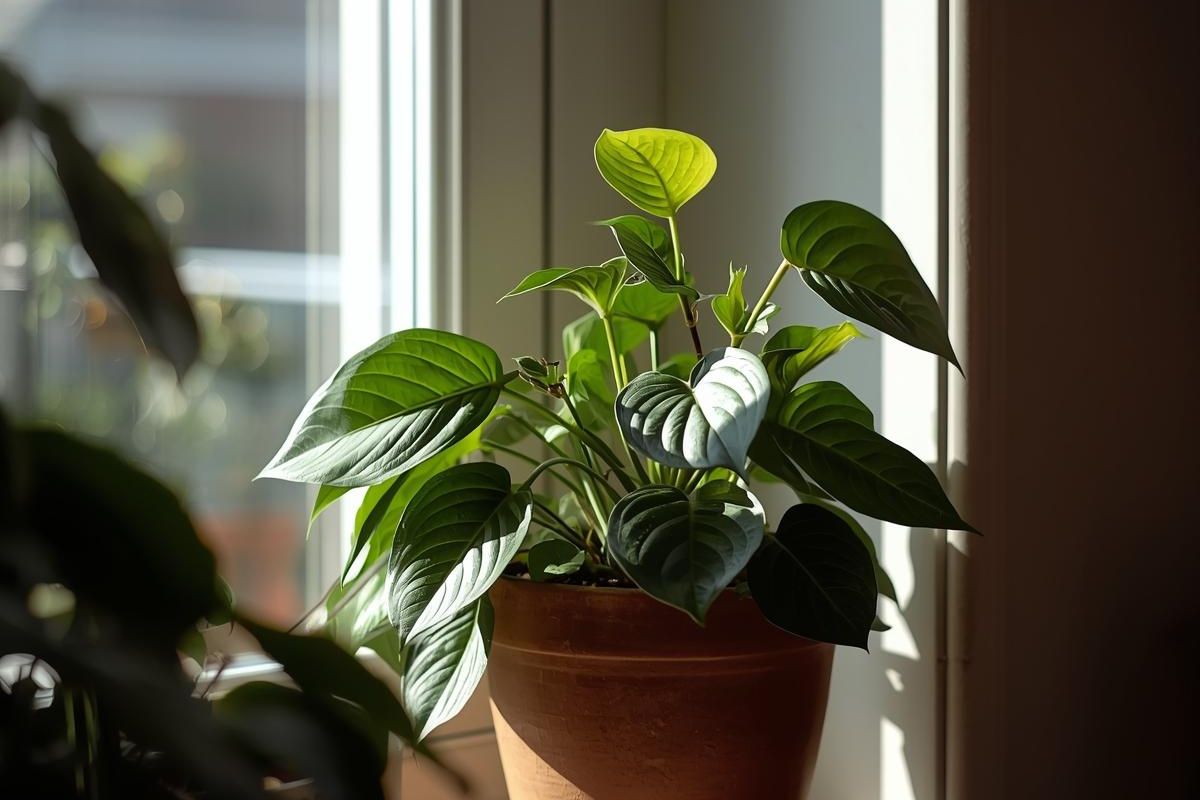
After mastering ZZ plant austerity, you can shift to Epipremnum aureum and its cultivars for trailing chroma that tolerates short days. Choose variegates—‘Marble Queen,’ ‘N’Joy,’ ‘Manjula’—for creamy fenestration-like marbling, or ‘Neon’ for chartreuse lamina that brightens dim corners. Provide bright, indirect photons (100–200 μmol·m⁻²·s⁻¹) to preserve variegation; reduce irrigation frequency as photoperiod shortens. Use a peat-free, airy substrate with perlite and bark to prevent hypoxia and root rot.
Place vines on shelves or in hanging planters—ideal pothos locations include east windows, stair landings, and offices with consistent 60–75°F. For pothos propagation tips: take 2–3 node cuttings, include one leaf and a healthy aerial root, then root in water or coarse mix; refresh water weekly. Fertigate lightly during active growth. Prune to maintain internode density.
Peace Lily: Elegant Blooms for Humid, Low-Light Spaces
While short days shrink light budgets, Spathiphyllum excels as a shade-tolerant aroid that rewards steady care with spathes and glossy foliage. Position your plant in bright-indirect to low light; avoid direct sun that scorches laminae. Maintain evenly moist, aerated substrate with high organic matter; let the top centimeter dry to prevent root hypoxia. Aim for 40–60% relative humidity; periodic misting or a pebble tray limits marginal necrosis.
For peace lily care, irrigate with dechlorinated water, keep temperatures 65–80°F, and fertilize at quarter-strength, balanced N-P-K during active growth. Repot when roots circle, using a chunky aroid mix. Deadhead spent spadices to trigger new inflorescences. Peace lily benefits include improved indoor aesthetics, potential VOC reduction per NASA-era studies, and reliable wilt-recovery signaling for timely watering.
Chinese Evergreen: Fall-Toned Foliage With Minimal Care
Though marketed as low-maintenance décor, Aglaonema earns its keep as a durable understory aroid with variegation that echoes autumnal palettes—copper, burgundy, and mottled olive—especially in newer cultivars bred for higher color under moderate light. You’ll maintain pigment by placing plants near bright, indirect light; avoid full sun, which chloroses leaves. Allow the top inch of substrate to dry, then irrigate thoroughly; excess salts cause marginal necrosis. Use a chunky, well-drained mix (peat or coir, perlite, bark) to stabilize roots and prevent hypoxia.
Keep temperatures between 65–80°F, with brief dips tolerated. Aim for humidity balance around 45–60% to limit tip burn and optimize stomatal function. Feed lightly with a balanced, dilute fertilizer during active growth. For air purification, larger, mature clumps offer greater leaf area, improving pollutant uptake. Paired with a pumpkin pot, this is a great DIY fall decor idea.
Rubber Plant: Bold Leaves That Thrive in Cooler Light
Because Ficus elastica tolerates lower photon flux than many figs, you can site it in bright, indirect to medium light—east or north exposures work—without sacrificing leaf gloss or turgor. Prioritize stable photoperiods and avoid direct midday insolation that induces foliar scorch. For rubber plant placement, maintain 40–60% relative humidity and temperatures of 65–75°F; brief dips to 60°F are tolerated.
Execute rubber plant care with a fast-draining, peat-free substrate amended with pine bark and perlite (air-filled porosity ~20–25%). Water when the top 1–2 inches dry; prevent hypoxic roots by discarding saucer runoff. Feed a balanced fertilizer at 1/4–1/2 strength during active growth. Rotate plants quarterly for orthotropic symmetry. Prune apical meristems to encourage lateral branching. Monitor for scale; apply horticultural oil on detection.
.jpg)
Anthurium: Long-Lasting Color to Brighten Gray Days
Glossy spathes and cordate leaves make Anthurium a photogenic choice for short-day seasons, provided you meet its tropical epiphytic needs. Give bright, indirect light (150–300 foot-candles) to sustain bract pigmentation and continuous spadix bloom. Maintain 60–70% relative humidity, warm roots (68–75°F), and a porous, aroid mix—orchid bark, perlite, and peat or coco coir—to prevent hypoxic roots.
Water when the top inch dries; aim for evenly moist, never waterlogged. Feed with a balanced, dilute fertilizer (e.g., 1/4 strength 20-20-20) every 4–6 weeks during active bloom. For anthurium care tips that boost longevity, remove spent inflorescences, flush salts quarterly, and repot annually to refresh aeration.
Explore anthurium color varieties—scarlet, coral, pink, white, green, even near-black cultivars—selecting compact hybrids for windowsills and larger forms for statement displays.
Calathea and Prayer Plants: Patterned Leaves for Moody Autumn Vibes
When shorter days push you indoors, marantaceous showpieces like Calathea, Goeppertia, and Maranta deliver high-contrast variegation and nyctinastic “prayer” movement that reads perfectly autumnal. You’ll get velvety laminae, abaxial burgundy undersides, and striking venation that pop in diffuse light. For precise calathea care, provide bright, indirect photons (100–200 μmol m−2 s−1), evenly moist but airy substrate (peat-free mix with fine bark, perlite), and high humidity (60–70%). Maintain 65–80°F, with minimal drafts; avoid calcium-rich tap water to prevent marginal necrosis.
Feed lightly with a balanced fertilizer at half strength during active growth. Bottom-water, then drain thoroughly to prevent hypoxic roots. The prayer plant benefits include circadian leaf folding that reduces transpirational stress, enhanced visual biofeedback for hydration cues, and proven particulate capture, improving indoor air quality.
Conclusion
As days shorten, you can curate a resilient indoor canopy. Select taxa matched to site conditions: low-PPFD niches suit Sansevieria and Zamioculcas; brighter exposures favor Ficus elastica and Anthurium. Use well-drained, peat-free substrates, irrigate by volumetric moisture (not schedule), and maintain 30–50% relative humidity for Peace lily and Marantaceae. Rotate containers for even phototropism, leach salts monthly, and wipe foliage to optimize gas exchange. You’ll sustain turgid leaves, steady transpiration, and season-long energy.


.svg)
.jpg)