
Winter Carpet Cleaning Tips to Protect Your Floors


Set a two-mat entry barrier: outdoor scraper + indoor absorbent (6–8 ft total), add boot trays, and vacuum daily. Treat salt within hours: mist 1 tbsp vinegar per 1 cup warm water, blot until clear, then apply a neutral pH encapsulating spotter and vacuum after dry. Manage moisture with high-absorbency runners, remove saturated mats, and keep RH 35–45%. Use neutral to mildly alkaline, low-residue cleaners. Maintain equipment and store dry under 50% RH—there’s more you can implement next.
- Create two-layer entry barriers with outdoor scraper and indoor absorbent mats covering 6–8 feet to stop snow, grit, and salt at the door.
- Treat salt stains within hours using a mild vinegar-water rinse, blot cycles, then a neutral pH encapsulating spotter once dry.
- Vacuum daily, focusing on high-traffic lanes; pile lift weekly and use microfiltration bags to remove fine winter grit.
- Remove and dry saturated mats promptly; launder or extract, and maintain indoor humidity at 35–45% to speed evaporation.
- Use neutral to mildly alkaline, low-residue cleaners and deicer-specific neutralizers; avoid butyl solvents and optical brighteners.
Build a Winter Entryway Defense
Start with a two-layer barrier at each entry: an outdoor scraper mat to remove grit and de-icing salts, and an indoor absorbent mat to capture moisture.
Choose a scraper mat with aggressive scraping treads and a closed-cell backing to prevent bleed-through; position it flush with the threshold to maximize first-step contact.
Inside, use a high-density microfiber or polypropylene mat with a nitrile rubber backing to lock in water and minimize creep.
Size both mats to cover at least three footfalls (about 6–8 feet combined).
Add boot trays adjacent to mats to intercept runoff.
Mount wall hooks for wet gear to reduce floor drip.
Vacuum mats daily with a beater-bar vacuum; launder or hose-rinse weekly.
Replace saturated mats promptly to maintain capture efficiency.
Stop Salt Stains Before They Set
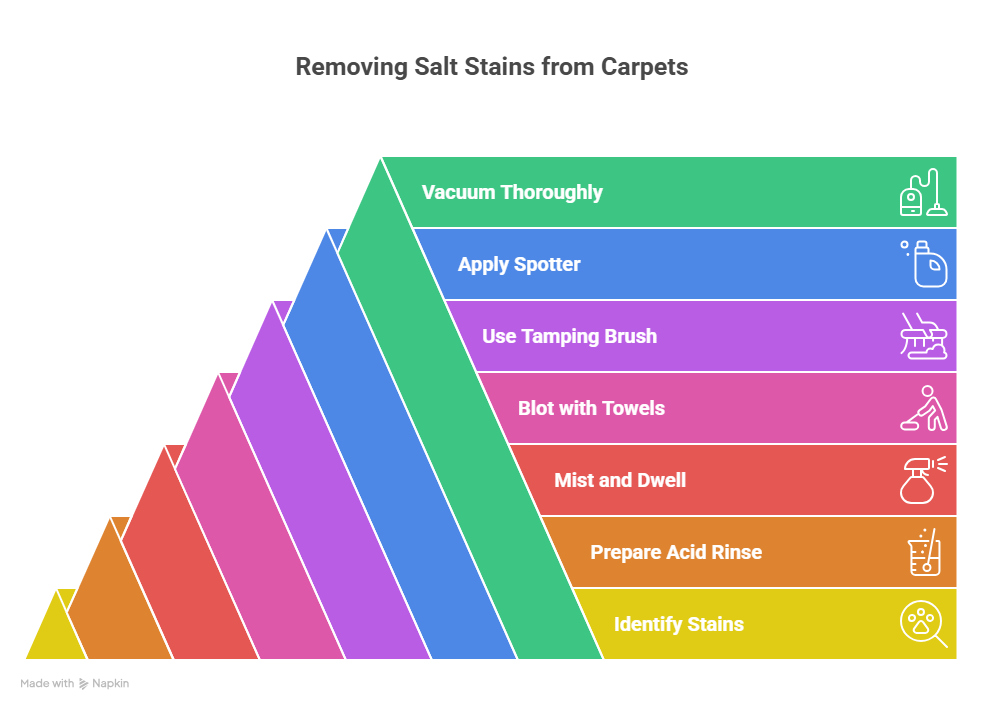
Because de-icing salts crystallize and wick upward as carpets dry, act within hours to prevent alkaline residue from etching fibers.
Identify white halos or stiff patches—typical sodium chloride or calcium chloride deposits. Don’t scrub dry; you’ll drive salts deeper.
Mix a mild acid rinse: 1 tablespoon clear white vinegar per 1 cup warm water (pH ~3). Lightly mist the stain to dissolve alkaline crystals; dwell 3–5 minutes. Blot with white, absorbent towels using firm downward pressure; rotate towels until transfer stops.
Repeat mist–blot cycles until no residue lifts. For dense pile, use a soft tamping brush to loosen impacted crystals without abrading tufts.
Finish with a neutral pH encapsulating spotter; blot again to prevent rapid resoiling. Vacuum thoroughly after fibers dry to remove remaining particulates.
Manage Moisture From Snow and Slush
After neutralizing salt residues, control the water that carries them in.
Place a coarse scraper mat outside and a high-absorbency microfiber or polypropylene mat inside. Aim for combined matting equaling 8–12 steps to remove >90% of moisture.
Remove saturated mats promptly; launder or extract and fully dry before redeploying.
Set boot trays at entrances and require shoe changes where feasible. Use weighted umbrella stands and drip pans to capture runoff.
Deploy hygrometers and keep relative humidity between 35–45% to accelerate evaporation without overdrying fibers.
Vacuum entry zones daily with a dual-motor upright, then perform targeted wet extraction on visible damp patches within 2–4 hours to prevent wicking.
Run fans on low with air moving parallel to carpet; avoid heat above 120°F to protect backing.
Protect High-Traffic Paths
Even when moisture is controlled at entrances, high-traffic lanes still take the brunt of abrasion and soil loading, so fortify them proactively.
Identify primary paths using a walkthrough and soil mapping; mark pivot points, elevator banks, reception routes, and coffee stations.
Install walk-off runners or carpet protectors rated with dense face weight and low pile to resist crushing.
Vacuum these lanes daily with a dual-motor upright or CRI Gold machine; use microfiltration bags to retain fine grit.
Perform pile lifting weekly to recover texture and release embedded aggregate. Spot-remediate particulates immediately to prevent grinding.
Rotate runners every two weeks to equalize wear.
Set a quarterly fiber-protection treatment schedule matched to carpet type and traffic counts.
Track wear indices and adjust frequencies before visual degradation appears.
Choose Winter-Safe Cleaning Solutions
While temperatures drop and salt use spikes, select chemistries that clean effectively without degrading fibers, dyes, or backing.
Prioritize neutral to mildly alkaline detergents (pH 7–8.5) for most nylon and solution-dyed carpets; reserve stronger alkalinity only for severe oil soils.
Use calcium chloride/magnesium chloride-specific neutralizers to dissolve deicer residues; verify compatibility with carpet type and adhesive system.
Choose low-residue, encapsulating polymers to limit re-soiling and reduce moisture load.
Avoid butyl solvents and optical brighteners that can strip stain-resist or distort color.
Check Safety Data Sheets: confirm low VOCs, corrosion-inhibitor presence for tackless strips, and freezing-point data for storage in unheated areas.
Perform a cold-condition spot test.
Dose precisely per manufacturer charts, pre-diluting with 100–120°F water.
After application, blot-rinse targeted spots to remove salts and detergent films.
Vacuum Smarter and More Often
Because winter foot traffic delivers sand, deicer fines, and abrasive grit, increase vacuum frequency and upgrade technique to control soil load and fiber wear.
Vacuum entry paths daily, main walkways 3–4 times weekly, and low-traffic rooms weekly. Use a quality upright with a calibrated beater bar; set pile height so bristles just touch tips, not crush fibers. Add a HEPA filter to capture PM2.5 and salt dust.
Make slow, overlapping passes—two per lane on cut pile, three on loop pile. Cross-hatch (north–south, then east–west) to lift embedded particulates. Empty the canister at 75% capacity to maintain airflow.
Replace bags and microfilters per manufacturer intervals. Inspect brushrolls for wrapped hair and replace worn belts. Place matting outside/inside entries to reduce incoming soil.
Spot Clean the Right Way
Daily vacuuming controls dry soils; the next threat is wet spots that set and wick during winter. Act fast. Blot, don’t rub—apply firm, repeated pressure with white microfiber to lift liquid vertically and prevent fiber abrasion.
Test any chemistry in an inconspicuous area. For salty slush, use a mild acidic rinse (about pH 4–5) to dissolve alkaline residues. For oily spots, choose a solvent-safe spotter; apply minimally and blot. For protein spills, use an enzyme spotter at label-directed dwell time, then blot and rinse.
Work from the spill’s edge toward the center to avoid spreading. Use the least aggressive method first. Rinse with cool water in a light mist and blot dry.
Place a folded towel and weight for two hours to suppress wicking. Ventilate until dry.
Deep Clean Without Overwetting
Even in freezing weather, you can deep clean effectively by controlling moisture, heat, chemistry, and agitation to protect backing and prevent wicking.
Pre-vacuum thoroughly to remove dry soil and improve chemical contact. Meter solution flow: target light spray patterns (about 0.3–0.5 gpm on portable/CRB systems). Use low-moisture detergents (encapsulation polymers, pH 7–8.5) and follow dwell times (5–10 minutes) without over-wetting.
Agitate with a CRB or soft brush pad to suspend soils.
Extract using high-lift, low-flow settings; make one wet pass and two dry passes. Increase solution temperature to 120–150°F to boost efficiency and reduce volume used.
Speed evaporation: set air movers at floor level, cross-flow the room, and lift corners of area rugs.
Verify dryness with a moisture meter; aim for ≤12% within two hours.
If you prefer professional help, choose a carpet cleaning in Kensington service that can explain how it will control moisture and manage drying in winter. Before booking, discuss your carpet type, any existing stains, and the ventilation available in your home.
Prevent Odors and Mildew
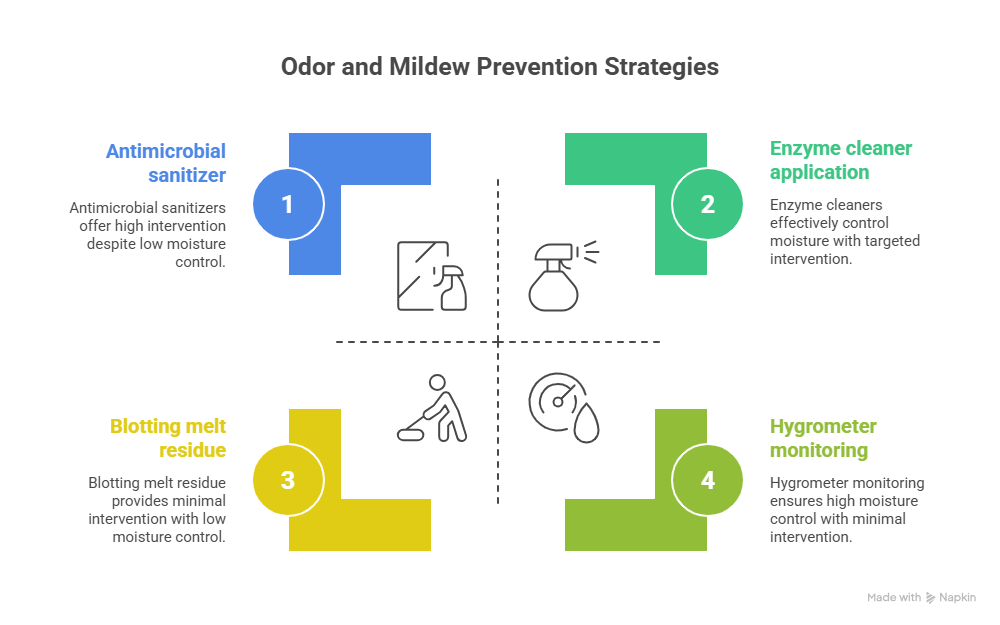
Tight moisture control from deep cleaning sets you up to stop odors and mildew before they start.
Next, verify dryness. Use a hygrometer and aim for room RH under 50% and carpet surface below 15% moisture with a pinless meter. Boost air exchange: run fans toward exits, crack windows briefly, and use a dehumidifier at 40–45% RH until readings stabilize.
Target odor sources fast. Blot tracked-in melt residue, then neutralize with a 1:1 mix of white vinegar and water; dwell 5–10 minutes; extract and dry.
For organic spills, apply an enzyme cleaner rated for carpets; follow label dwell time; rinse lightly; accelerate drying. Treat suspect padding zones with an EPA-registered antimicrobial sanitizer safe for soft surfaces.
Monitor 24–48 hours; retreat only if readings rebound.
Maintain and Store Gear Between Storms
Two routines keep winter gear reliable: post-job maintenance and storm-gap storage.
Rinse extractor tanks, hoses, and nozzles with 120–130°F water to dissolve soils and deicer residues. Flush pumps for 60 seconds with clean water, then run a 1:10 white-vinegar solution to limit mineral scale; finish with a clean-water rinse.
Remove, launder, and fully dry microfiber pads at low heat; high heat fuses fibers and reduces absorption.
Dry gear completely within 24 hours. Use forced air or desiccant packs in sealed bins to keep relative humidity under 50%.
Lubricate reel bearings and quick-connects with silicone-safe lubricant. Charge and store batteries at 40–60% state of charge near 50–70°F.
Coil cords loosely, inspect GFCI integrity, label repairs, and stage kits for the next storm.
Conclusion
Winter floors stay cleaner when you act early and precisely. Build a barrier at the door, neutralize salt immediately, and extract moisture fast. Protect traffic lanes with runners, use pH-appropriate products, and spot clean with minimal dwell. Deep clean using low-moisture methods to avoid wick-back. Ventilate and dehumidify to prevent odors and mildew. After each storm, inspect, launder, and dry mats and tools. Stay consistent, measure results, and adjust your routine to keep carpets durable, safe, and sanitary.


.svg)

.jpg)
.jpg)
.jpg)