
Your Small Living Room Needs Two Pieces, Not a Dozen Bins

.jpg)
The remotes are on the coffee table. Board games are stacked in a corner. Charging cables live on the floor next to the TV because there is nowhere else to put them. If this sounds familiar, the issue usually isn't that your living room is too small. It's that your furniture isn't doing enough.
Most small-space storage problems get tackled with more bins, more baskets, more shelving units. It rarely works. What actually works is choosing two furniture pieces that carry most of the load. Here's how that plays out in a real living room.
Why a Modular Setup Makes More Sense in a Small Living Room
In a small home, the first instinct is to buy smaller. A tiny TV stand, a shorter bookshelf, a narrower console. It feels logical. It rarely works because the problem isn't the individual pieces. It's that nothing is doing enough work per square foot.
A well-configured modular entertainment center solves this in a way a standard TV stand can't. You're not buying a fixed-width cabinet and hoping it fits. You're picking sections based on your actual wall and arranging them around your real storage needs, not the other way around.
Practically, that means one unit can hold your TV, your streaming devices, books, a few decorative pieces, and a basket or two of things you'd rather not see. In a small living room, consolidating that much into one piece makes a visible difference.
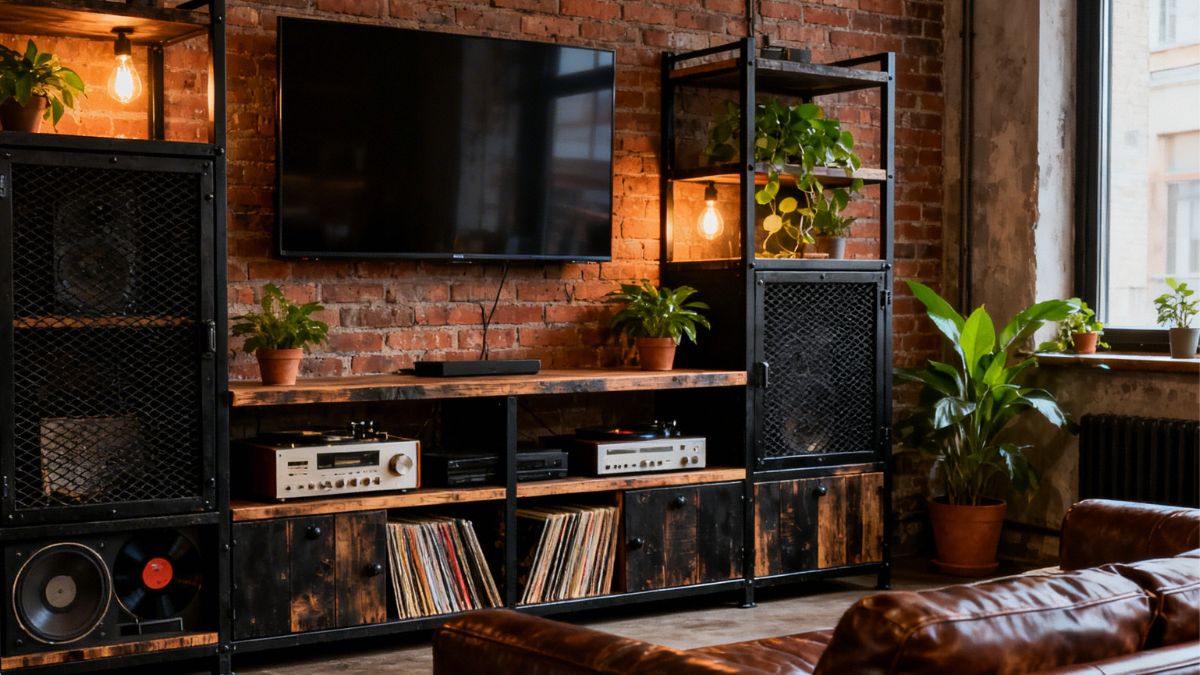
It handles the TV area without wasting wall space
A traditional TV console usually sits too low and too narrow, leaving empty wall space above and beside it. A modular setup fills that wall more intentionally: taller side sections for books or stored items, a lower center section for the screen, a unit that becomes a feature instead of dead space.
The open shelves keep daily items actually reachable
Remotes, a candle, the book you're currently reading, your dog's toy: these don't need to be hidden. They just need a spot. Open shelving built into a modular unit gives everyday items a home without making them impossible to grab.
When a Sideboard Helps More Than People Expect
Here's where most small living room setups fall short: they nail the TV wall and then forget about everything else. The result is one organized surface and chaos everywhere around it.
Adding a sideboard cabinet along the opposite or adjacent wall rounds out the storage without adding visual bulk. It sits low (usually between 30 and 36 inches tall), so it doesn't cut the room in half visually. You still get the open feel of a small space, with a meaningful amount of hidden storage behind closed doors.
A sideboard is more flexible than most people realize. It can hold board games, a spare blanket, charging cables, the mail that needs sorting, and any overflow that tends to pile up near entryways. In a studio or open-plan apartment, it can also act as a soft divider between zones.
It works in spots where a big cabinet won't fit
Behind the sofa, under a window, along a short wall: these are spots where a wardrobe or tall bookcase would feel wrong. A sideboard slides right in and turns what would be dead space into actual storage.
The top surface does double duty
You don't need a separate console table if you have a sideboard. The top handles the same job: a lamp, a plant, a tray. The difference is that underneath, there's real storage, not just legs.
.jpg)
How to Divide One Small Room Into Useful Zones
The real key to storage in a small living room isn't more furniture. It's a smarter positioning of fewer pieces.
The TV wall zone
This is where your modular unit lives. Anchor it to the main wall, ideally opposite the sofa. Height-wise, try not to go above your door frame. Anything taller starts to feel like it's closing in.
The overflow storage wall
The sideboard belongs here, on the wall perpendicular to the TV, or behind the sofa if the room allows it. Keep at least 24 to 36 inches of clearance between any two furniture pieces so the room still feels walkable.
The everyday drop zone
Pick one spot where daily items land and stay. A small tray on the sideboard works well. A basket tucked into the entertainment unit works too. Without a designated spot, stuff spreads across every surface by default.
What to Store Where
Being specific here matters because vague storage plans fall apart fast; this is exactly where home organizing services makes a difference.
What goes in the entertainment center
Streaming devices, game controllers, and cables belong in the closed sections. Books and decorative objects go on open shelves. Extra blankets can be rolled and stored in a lower cabinet.
What goes in the sideboard
Think seasonal and secondary: backup linens, board games, paperwork you need occasionally, pet supplies, anything that doesn't need to be grabbed daily. A few baskets inside keep smaller items from sliding around and make the cabinet feel organized, even when it isn't perfect.
.jpg)
Mistakes That Make a Small Living Room Feel Even Tighter
One oversized piece that tries to do everything
A single massive wall unit sounds efficient. In practice, it dominates the room and kills flexibility. Two well-chosen, appropriately sized pieces do more work with less visual weight.
Too many small bins solve nothing
Fifteen decorative baskets on open shelves don't fix clutter. It just relocates it in a more photogenic way. Fewer pieces with more closed storage is almost always the smarter call in a compact space.
Depth that cuts off traffic flow
Check the depth before anything arrives. A bookcase or sideboard that sticks out 18 inches into a narrow walkway will make the room feel smaller than it is. Most sideboards run 14 to 18 inches deep, worth confirming before you buy.
The Bottom Line
Small living rooms don't need more storage. They need better storage positioned intentionally. A modular entertainment center handles the TV wall and the daily clutter. A sideboard fills the gaps without taking over the room. Together, those two pieces cover most of what a small living room needs to function and feel like home.


.svg)
.jpg)
.jpg)
.jpg)