
The Hidden Cost of Flat-Pack: Why Fully Assembled Furniture is the New Luxury

.jpg)
We’ve all been there. It is a Saturday morning. The sun is shining, and you have a whole weekend of relaxation ahead of you. But then, the doorbell rings. The delivery truck has arrived. You drag three heavy, rectangular cardboard boxes into your living room. You slash open the tape, expecting to see your new media console. Instead, you are staring at a chaotic pile of 40 wooden boards, a bag of 200 mixed screws, and a confusing instruction manual that seems to be written in hieroglyphics.
Your relaxing weekend just evaporated.
Welcome to the "Flat-Pack Paradox." For decades, we have been conditioned to believe that flat-pack furniture is the smart financial choice. It seems cheaper upfront, it fits in your car, and it promises a vague sense of accomplishment. But as our lives get busier and our standards for quality rise, homeowners are waking up to a harsh reality: that "affordable" price tag is hiding significant costs.
In the modern home, true luxury isn't just about gold accents or velvet upholstery. True luxury is about convenience, time, and peace of mind. Here is why the era of the Allen key is ending, and why fully assembled furniture is the investment you actually need to make.
The "Time Tax": Calculating What You Really Pay
Let’s talk about the most valuable currency you own: your time. When you buy a piece of furniture that requires assembly, you aren't just paying the retail price; you are essentially signing a contract to work for free.
Let’s do a quick math exercise. Imagine you bought a complex TV stand for $300. It looks like a steal. However, assembling a unit with drawers, hinges, and alignment adjustments can easily take an inexperienced person 3 to 4 hours. If you value your free time at, say, $30 an hour (a conservative estimate for your precious weekend leisure time), that "cheap" console just cost you an extra $120. That brings the real price to $420. And that doesn't even account for the physical energy you spent or the frustration you endured.
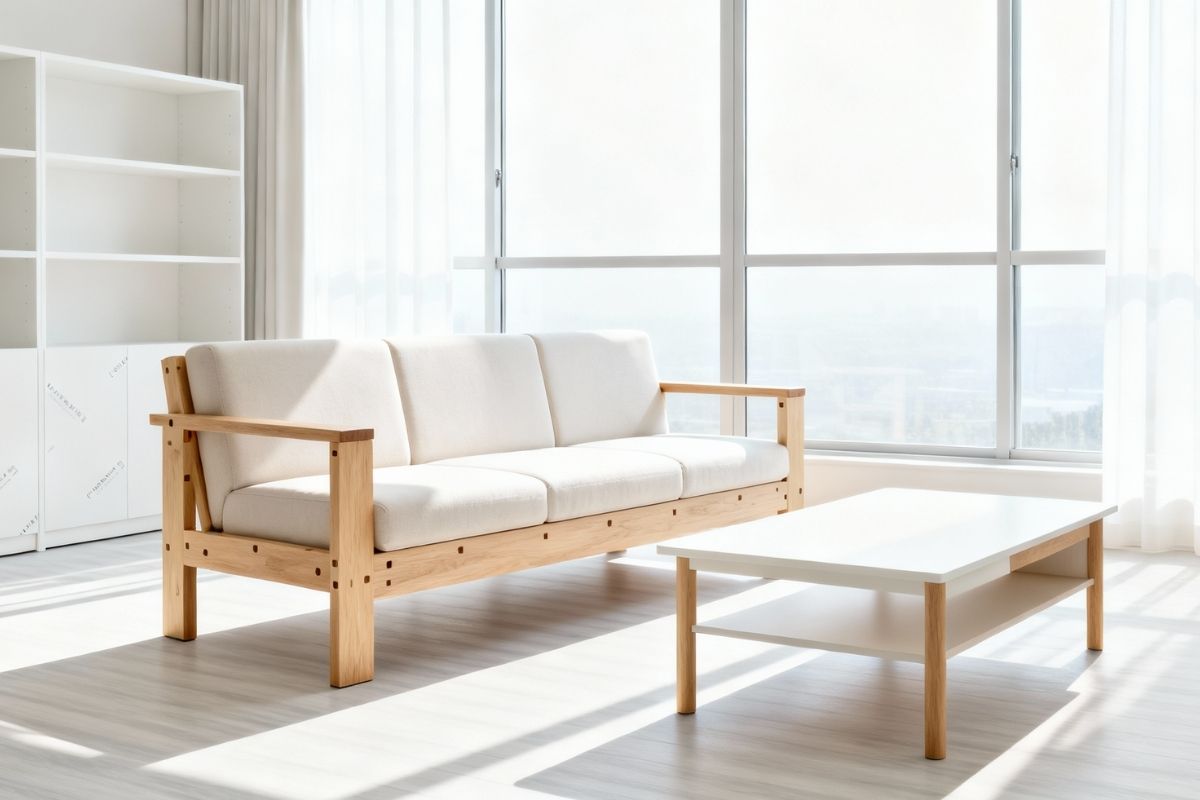
This is where the value proposition shifts dramatically. When you choose Povison Furniture, which specializes in fully assembled pieces, the equation changes entirely. The delivery arrives, you unbox it, and you place it. That’s it. You are done in five minutes. You instantly reclaim your Saturday afternoon to read a book, play with your kids, or just nap on that new sofa. In a world where we are constantly rushing, eliminating the assembly process is the ultimate way to buy back your time.
Structural Integrity: Factory vs. Your Living Room Floor
Have you ever noticed that flat-pack furniture tends to "wobble" after a year? Or that the drawers never quite sit flush? This isn't necessarily because you are bad at building things (though we can't all be master carpenters); it is a fundamental engineering flaw of the flat-pack system.
To make furniture shippable in flat boxes, manufacturers have to rely on specific types of hardware—primarily cam locks, wooden dowels, and particle board.
- The Problem with Cam Locks: These are those little metal discs you turn to lock pieces together. They rely on tension. Over time, with daily use and vibration (like opening and closing a drawer), these fittings naturally loosen. The furniture starts to sway.
- The Material Limit: Flat-pack furniture rarely uses solid hardwood or heavy stone because it would be too heavy for a customer to lift and assemble. It almost exclusively relies on MDF or hollow-core boards, which can crumble if a screw is overtightened.
The Factory Advantage Fully assembled furniture is built differently. Because it doesn't need to be broken down into pieces, it can be constructed using professional joinery techniques—like dovetail joints, industrial-strength adhesives, and welding.
Take a Sintered Stone TV stand, for example. The heavy stone top and the solid wood or metal framework are assembled by professionals using industrial tools. The result is a solid, cohesive unit that feels grounded. It doesn’t wobble when you touch it. It is built to last a decade, not just until your next move.
The "Relationship Test" (and Mental Load)
There is a running joke that assembling furniture together is the ultimate test of a relationship. While it sounds funny, the stress is real.
Psychologists talk about "decision fatigue." By the end of a work week, your brain is tired of making choices. Flat-pack assembly forces you to make hundreds of micro-decisions: Is this Screw A or Screw B? Which way does this hinge face? Did I put this panel on backward?
This creates unnecessary mental load. Your home should be your sanctuary, a place where stress melts away. Bringing a box of frustration into your living room disrupts that energy.
Choosing a fully assembled piece is a form of self-care. It eliminates the "anxiety of error." You don't have to worry about scratching the finish before you’ve even used it, or realizing halfway through that you’re missing a critical part. You simply enjoy the product immediately.
Design Freedom: Breaking the "Boxy" Mold
There is a reason most flat-pack furniture looks the same: boxy, sharp corners, and simple lines. It has to be square to fit into a flat cardboard box.
When you remove the restriction of flat-packing, design possibilities explode.
- Curved Silhouettes: You can have elegant, rounded corners and fluid shapes that soften the look of a room.
- Mixed Materials: Designers can combine heavy sintered stone, tempered glass, leather, and metal in ways that would be impossible to package flat.
- Seamless Finishes: Fully assembled pieces don't have visible "cam lock holes" or plastic caps covering screws on the side panels. The finish is smooth, clean, and 360-degree perfect.
If you look at the modern, minimalist trends for 2025, they favor organic shapes and seamless integration. This aesthetic is almost impossible to achieve with a DIY kit.
.jpg)
The Environmental Perspective: Buy Once, Buy Right
We live in the age of "Fast Furniture"—items made cheaply, bought quickly, and discarded the moment they break or become inconvenient to move. Flat-pack furniture is the biggest culprit. Because it loses structural integrity when disassembled, most people throw it away when they move house rather than trying to take it apart and rebuild it.
This contributes to millions of tons of furniture waste filling landfills every year.
Factory-assembled furniture is inherently more sustainable because of its longevity. A sturdy, pre-built sideboard is an heirloom piece. It survives moving trucks. It survives toddlers. It survives daily life. When you buy a higher-quality, pre-assembled item, you are making a commitment to keep it for the long haul. That is a win for your wallet in the long run, and a win for the planet.
Conclusion: Elevate Your Living Standard
It is time to reframe how we look at the price of furniture.
When you see a price tag on a high-quality piece, you aren't just paying for the wood, the stone, and the metal. You are paying for the professional craftsmanship that put it together. You are paying for the 4 hours of your life you get to keep. You are paying for a piece of art that arrives ready to impress, with zero effort required on your part.
Your home is a reflection of your life. Don't build it on a foundation of loose screws and particle board. Choose the ease, beauty, and permanence of fully assembled furniture. Because the greatest luxury of all? It’s simplicity.


.svg)
.jpg)
.jpg)
.jpg)