
How to Heat and Cool a Tiny House Without Wasting Space or Power

.jpg)
Living in a tiny house means every square foot matters. It also means temperature swings hit harder and faster. A 300-square-foot space can go from comfortable to stuffy in minutes once the sun shifts or the outside temp drops.
Most people start with what they know. A window AC unit. A portable space heater. Maybe an RV rooftop system. These all technically work, but they come with trade-offs that get old fast. Window units block your view and kill airflow. Space heaters eat electricity and only warm the spot right in front of them. RV systems are loud and not built for year-round comfort. In a regular house, you can live with these flaws. In a tiny house, they take over your daily life.
What actually fits the tiny house lifestyle is a mini split AC, a wall-mounted system that handles both heating and cooling without stealing your floor space or draining your power supply. To understand why, it helps to look at what goes wrong with the usual options first.
Why Traditional HVAC Makes No Sense in a Tiny House
Traditional heating and cooling equipment was designed for traditional homes. That mismatch creates real problems when you try to shrink things down.
Window AC Takes More Than a Window
A window unit does not just block light. It removes one of your few ventilation options. In a tiny house with maybe four windows total, losing one to a bulky AC unit changes the whole feel of the space. Cross breezes disappear. Natural light drops. And you are stuck with a unit that drips, hums, and looks out of place.
Space Heaters Are a Poor Fit
Portable heaters pull 1,000 to 1,500 watts. In a small space, that is a huge chunk of your electrical capacity. They create hot spots near the unit and cold spots everywhere else. In a home where your bed is six feet from your kitchen, a heater on the floor is also a safety concern.
RV Units Were Not Designed for This
Rooftop RV units are built for occasional use during road trips, not for keeping a permanent home comfortable year-round. They are noisy, inefficient, and most require roof reinforcement to install.
What a tiny house actually needs is something that mounts out of the way, runs quietly, and uses minimal power. That is the basic idea behind ductless wall-mounted systems, and it is why they keep showing up in tiny house builds.
.webp)
Why Most Tiny Houses Only Need a 12k BTU System
A common mistake is buying a system that is too powerful for the space. Bigger is not better when it comes to climate control in a small footprint.
Here is the simple math. For every square foot of living space, you need roughly 20 to 30 BTU of cooling capacity. A typical tiny house runs between 200 and 400 square feet. That puts the sweet spot right around 6,000 to 12,000 BTU.
A system that is too large will short cycle. It turns on, blasts air, hits the target temperature fast, and shuts off. Then the temperature drifts, and the cycle repeats. This wastes energy and wears out the compressor faster.
A 12,000 BTU mini split is the most popular choice for tiny houses because it covers the upper range without overshooting. It runs longer at lower power, which keeps the temperature steady and the electric bill predictable. For most tiny house owners, this is the one number that matters.
Wall Space Matters More Than People Think
In a tiny house, walls are not just walls. They hold shelves, fold-down desks, hanging storage, pegboards, and sometimes even your bed frame. Every vertical surface has a job.
That is why floor-standing or window-mounted equipment creates such a headache. A portable AC takes up two square feet of floor space you cannot spare. A window unit removes wall space you could have used for a cabinet.
A ductless indoor unit mounts high on the wall, near the ceiling. It sits above your usable space and does not interfere with anything below. You keep your storage, your design, and a clean visual profile instead of a clunky box on the floor or hanging out of a window.
Off-Grid, Solar, and Power Efficiency Considerations
A lot of tiny house owners run on solar panels or limited hookups. That makes power consumption one of the biggest factors in choosing any appliance.
Here is what matters most:
- Startup draw. Some systems spike to 2,000 watts or more when the compressor kicks on. If your inverter cannot handle that spike, the system will not start.
- Running watts. A mini split with an inverter compressor typically runs between 300 and 700 watts during normal operation. Compare that to a space heater pulling a constant 1,500 watts.
- Heating mode. Heat pump systems move warmth rather than generate it, which means they use far less electricity than resistive heaters. In mild climates, this can cut your heating costs by more than half.
For anyone relying on solar or a generator, these differences determine whether your system runs all day or drains your battery bank by afternoon.
Real Installation Layouts for Tiny Homes
Where you mount the indoor unit matters as much as what you buy. The right placement keeps air moving evenly and avoids dead zones.
Three layouts work well in most tiny house floor plans:
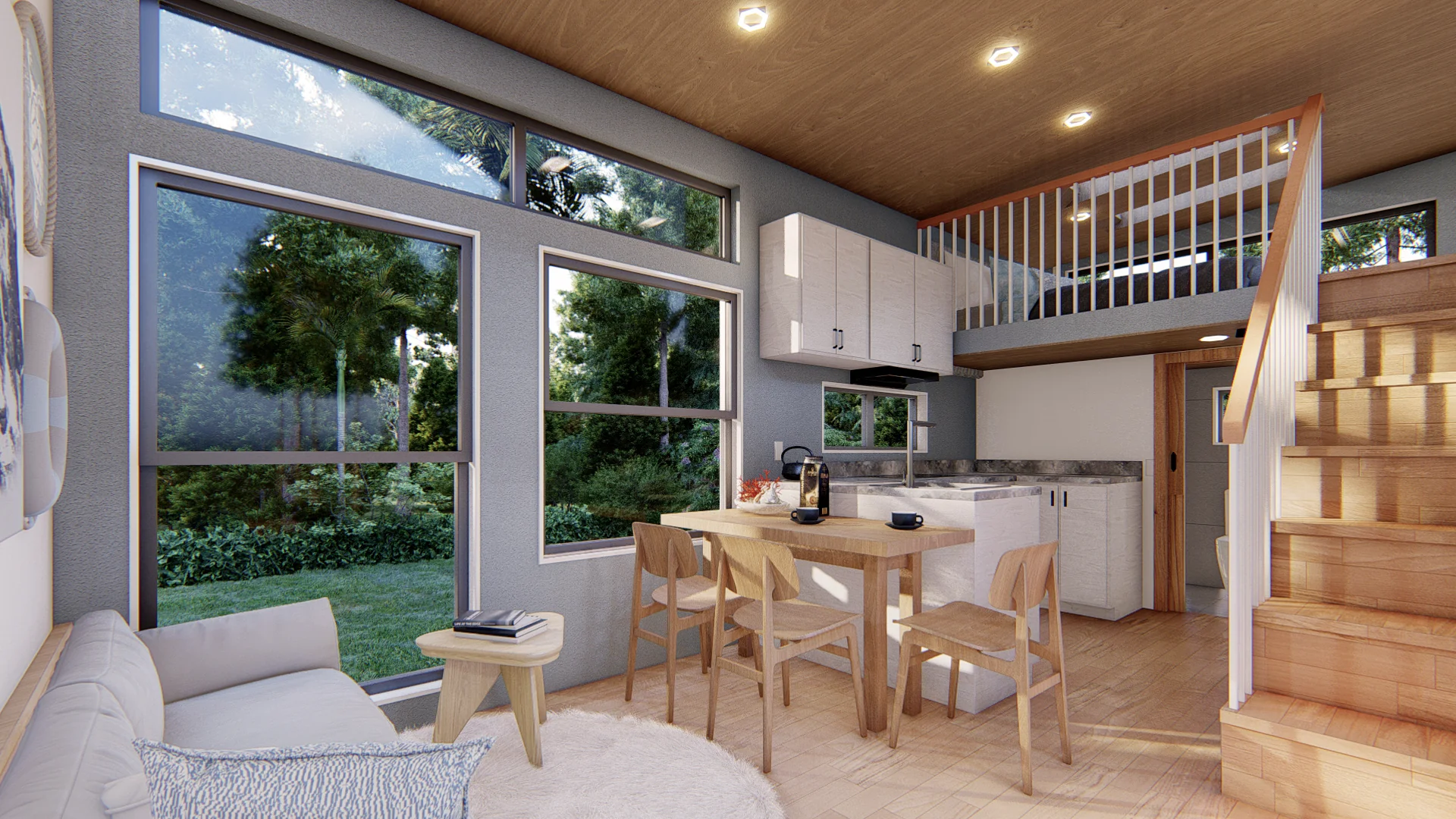
- Below the loft edge. If your sleeping loft sits above the main living area, mounting the unit just below the loft directs air across the open space below while also pushing some airflow up toward the bed.
- Above the entry door. This position works well in longer, narrow layouts. Air flows the length of the house, reaching the far wall before circulating back.
- High wall opposite the bed. In single-level tiny houses without a loft, placing the unit on the wall facing your sleeping area gives you direct airflow control where you spend the most time.
All three positions share the same logic. They sit high enough to distribute air evenly, stay clear of your walking path, and leave the wall below open for shelving or furniture.
Wrapping Up
The core challenge of a tiny house has always been the same. You want full comfort in a fraction of the space. That means every piece of equipment needs to earn its place.
Heating and cooling should not take up floor space, block your windows, or drain a solar battery in three hours. It should not force you to choose between staying warm and keeping your layout intact.
A system that mounts high on the wall, runs quietly, and sips power instead of gulping it is the one that fits the tiny house way of thinking. The space is small. The solution should be, too.


.svg)
.jpg)
.jpg)
.jpg)