
Luxury Vinyl Tile Bathroom Flooring Ideas

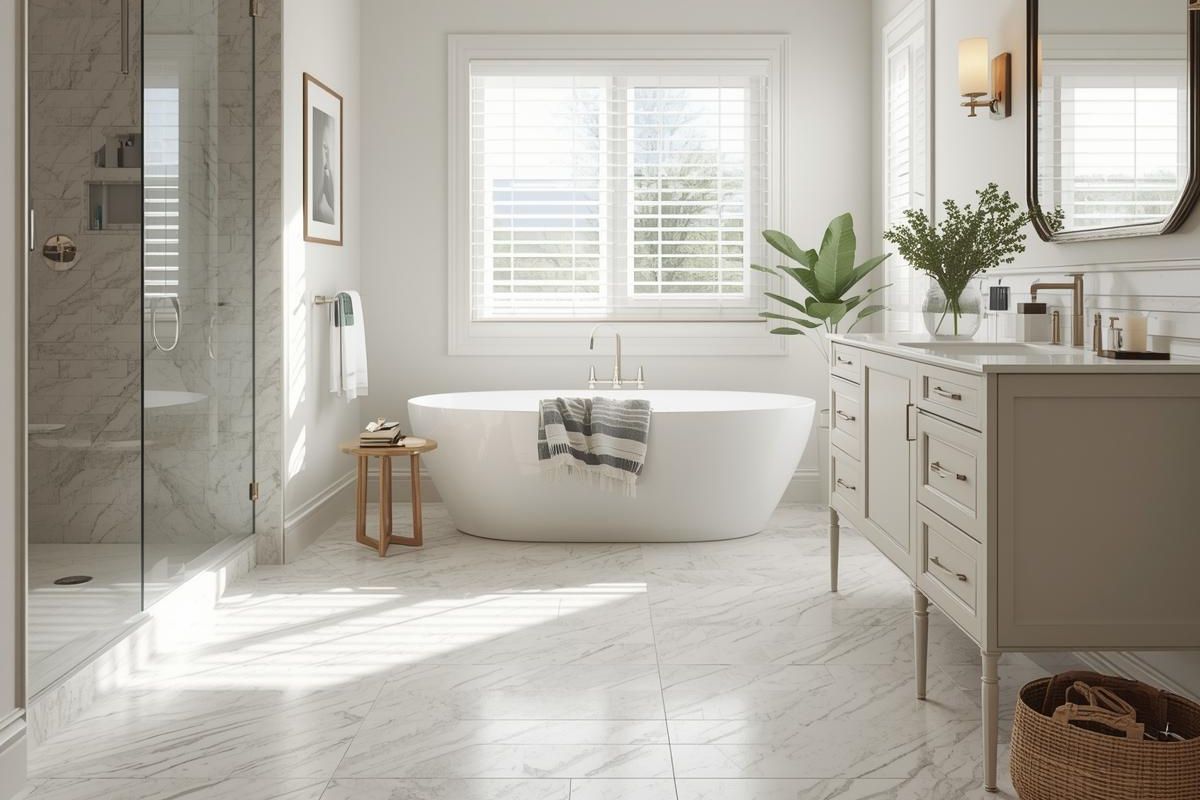
Elevate your bath with LVT: choose stone-look or marble visuals with matte/honed urethane wear layers (20–28 mil) and slip resistance ≥ R10 or 0.42 DCOF. Opt for rigid SPC/WPC cores—waterproof, stable over radiant heat—with integrated underlayment. Go wood‑plank in herringbone (4:1/5:1 ratio), or bold geometrics; confirm low repeat patterns (1:12+). Use click‑lock over flat subfloors, 1/8-inch perimeter gaps, and 1/16-inch grout lines where rectified looks apply. Seal wet zones and plan precise layouts to master the outcome.
- Choose stone-look LVT with textured wear layers, R10+ slip resistance, and waterproof SPC/WPC cores for a spa-calm, radiant-heat-friendly bathroom.
- Opt for marble-inspired LVT tiles with matte urethane coats, low pattern repeat (1:12+), and 1/16-inch flexible grout lines for a luxe look on budget.
- Use wood-plank LVT in standard or herringbone layouts; confirm 4:1 or 5:1 plank ratios and seal wet zones with manufacturer-approved seam sealer.
- Create statement floors with bold geometric LVT; center layouts with chalk lines, dry-fit, and finish perimeters with color-matched silicone.
- Prioritize textured finishes (micro or registered emboss) meeting ANSI A326.3, 20–28 mil wear layers, and integrated underlayment for grip and comfort.
Stone-Look LVT for a Spa-Calm Retreat
When you want a bathroom that feels like a spa without the upkeep of real stone, choose stone-look LVT with high-resolution imaging, beveled edges, and a textured wear layer that mimics honed marble, limestone, or slate. You’ll get natural aesthetics and a serene ambiance with measurable performance: 20–28 mil wear layers resist scratches, while urethane coatings improve stain repellence. Specify waterproof SPC or WPC cores for dimensional stability, and target low thermal expansion to suit radiant heat systems. Opt for slip-resistant finishes rated at least R10 and micro-bevels that channel water toward the drain. Use click-lock planks over a flat, clean subfloor; maintain a 1/8-inch perimeter gap. Seal connections, run silicone at wet-wall junctions, and follow manufacturer grout-line visuals for consistent layout.
Marble-Inspired Patterns on a Practical Budget
Prefer the polish of marble but need a tighter spend than natural stone or premium porcelain? Choose LVT tiles that replicate marble aesthetics with high-resolution film layers and a matte or honed urethane wear coat. Compare vein fidelity, repeat frequency (aim for 1:12 or better), and edge detail. Select rectified-look edges for tight 1/16-inch grout lines using flexible, premixed grout compatible with vinyl.
Specify a 20–28 mil wear layer and at least a 6 mm overall thickness for stability. Look for rigid core (SPC) to handle bathroom humidity and temperature swings. Confirm waterproof rating, integrated underlayment, and slip resistance of ≥0.42 DCOF. Prioritize budget friendly options by buying cartons from the same dye lot. Dry-fit layouts to align veining, then roll seams per manufacturer.
Wood-Plank LVT and Herringbone Layouts
Although it mimics site-finished oak or walnut, wood‑plank LVT gives you bathroom‑ready performance and precise layout control, especially in a herringbone pattern. You’ll get natural aesthetics with realistic graining, beveled edges, and matte wear layers that resist moisture and stains. Select planks with a rigid core and integral underlayment to stabilize over heated slabs and control telegraphing.
Plan your herringbone with exact module math: confirm plank length-to-width ratio (typically 4:1 or 5:1), snap perpendicular control lines, and dry-lay to center arrows on the room’s focal axis. Use manufacturer-approved installation techniques: flat substrate (≤3 mm over 2 m), perimeter expansion gaps, and pressure-sensitive adhesive or click‑lock per spec. Roll with a 50–75 lb roller. Scribe-cut at walls, undercut jambs, and seal wet zones with compatible seam sealer.
.jpg)
Bold Geometrics and Statement Floors
Even in compact baths, bold geometric LVT turns the floor into a controlled focal plane that anchors fixtures and mirrors. You’ll define sightlines with high-contrast graphic patterns—chevrons, hex grids, or tessellations—and align edges to door thresholds and vanity bases for visual order. Choose bold colorways that coordinate with grout-tone bevels and metal finishes; specify wear layers of 20–28 mil for durability and stain resistance.
Plan the layout: snap chalk lines from the room’s center, dry-fit tiles, and balance cuts so perimeter slivers exceed 2 inches. Rotate patterns to direct movement toward the shower or window. Use pressure-sensitive adhesive compatible with LVT and a 100-lb roller for bond integrity. Finish with color-matched silicone at wet perimeters and low-profile connections at adjacent flooring.
Textured Finishes for Grip and Comfort
Because bathrooms demand traction without sacrificing comfort, specify LVT with engineered surface textures that increase slip resistance and soften footfall. Look for textured surfaces such as micro-emboss, registered emboss, and wire-brush patterns that align with the wear layer to enhance grip under wet conditions. Verify coefficients of friction that meet or exceed ANSI A326.3 or equivalent wet DCOF standards. Choose thicker wear layers (20–28 mil) with matte urethane finishes and fine particulate additives for durable, low-glare traction.
Evaluate comfort via underfoot resilience: select SPC or WPC cores with integrated foam or cork pads in the 1–1.5 mm range to absorb impact and reduce noise. Seal perimeter edges and use waterproof adhesive or click-lock systems to prevent moisture intrusion and maintain consistent slip resistance.
.jpg)
Color Strategies for Small or Low-Light Baths
When square footage and daylight are limited, use LVT color and value to manipulate perceived brightness and scale. Choose light enhancing hues—neutral ivories, pale greiges, and cool driftwood tones—with LRV (Light Reflectance Value) above 60 to bounce available light. Apply color psychology: cooler undertones (blue-gray, soft taupe) recede visually, making floors feel broader; avoid high-saturation darks that compress the field.
Specify low-contrast graining and fine, diffuse patterns to prevent visual clutter. Large-format planks or tiles in the same value as the wall base minimize breaks and elongate sightlines. Run planks parallel to the longest wall to extend perceived length. Use matte or satin finishes to reduce glare bands that segment space. If you need warmth, select desaturated sand tones, not yellow casts.
Waterproof Performance and Low-Maintenance Tips
Light-optimizing palettes set the scene; now specify LVT that performs under splashes, steam, and routine cleaning. Choose rigid-core planks with welded seams or click-lock edges plus an attached waterproof underlayment. Verify a 100% PVC or SPC core, closed-cell foam backing, and a wear layer of 20–28 mil with ceramic or urethane topcoat to maximize waterproof benefits and stain resistance. Seal perimeter gaps with silicone at tubs, showers, and toilets.
For low maintenance cleaning, dry-dust daily with a microfiber pad. Spot-wipe spills immediately. Weekly, damp-mop using pH-neutral vinyl cleaner; avoid oil soaps, wax, steam mops, and abrasive pads. Maintain entry mats, trim pet nails, and use felt pads under furniture. Keep grout-look LVT lines debris-free with a soft brush. Inspect connections and re-caulk as needed.
Conclusion
You’re ready to specify LVT that performs and looks premium. Prioritize waterproof cores, rigid click systems, and high mill wear layers (20+ mil) for durability. Choose stone- or marble-look tiles with beveled edges, or wood-plank formats in herringbone for visual width. Use embossed textures for slip resistance (≥R10) and comfort. Balance light, low-sheen tones in small baths; add bold geometrics as a focal zone. Finish with perimeter expansion gaps, 100% silicone at wet areas, and pH-neutral maintenance.


.svg)
.jpg)
.jpg)
.jpg)