
The Storage Math Behind a Livable Tiny House

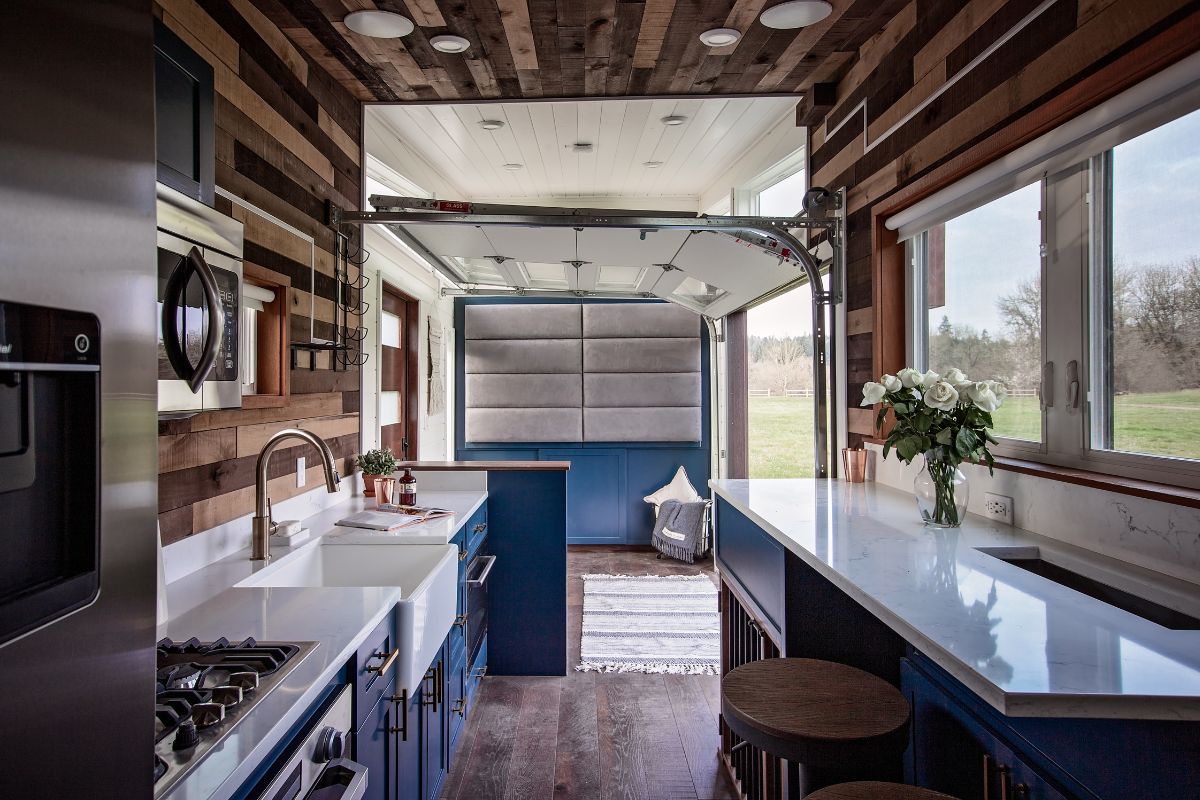
Square footage receives the most attention in tiny house discussions. Storage does the real work.
A tiny home can look calm on day one, then slowly tighten around its occupants as everyday objects pile up with nowhere sensible to go. Shoes drift toward doorways. Kitchen tools migrate onto counters. Closets become improvised junk drawers. The issue usually isn’t “too much stuff.” It’s the math. How much space exists, how accessible it is, and how many jobs each surface is quietly being asked to do.
In a tiny house, storage isn’t a nice-to-have. It’s the system that keeps the place running. It decides how you move through the space, how your days flow, and whether the house still feels good to live in months later. Miss by a couple of inches and you’ll notice it every time you cook, clean, or try to put something away. Nail it and the whole place feels steady, capable, and bigger than it has any right to.
That’s the difference between a tiny house that looks efficient and one that truly supports a real life.
The Square-Footage Illusion
Two tiny houses can share the same footprint and feel completely different. One feels cramped before breakfast. The other stays easy to live in all day. People blame layout, light, or furniture, but those are surface explanations. The real difference is how space is being counted, and where it’s quietly being lost.
Square footage is a blunt measurement. It ignores wall thickness, ceiling pitch, and the awkward zones created when doors swing into narrow walkways. A plan might promise 200 square feet, yet a surprising portion never becomes usable storage or workable space. Shallow cabinets that can’t hold real objects, dead corners behind doors, and gaps left to accommodate standard dimensions all take their cut.
In small homes, inefficiency compounds. A few wasted inches in the kitchen push storage into the living area. A cabinet run that stops at a “normal” height leaves valuable wall space doing nothing. What reads as a minor inconvenience in a larger house becomes friction here: extra steps, constant rearranging, surfaces that never stay clear.
Square footage can tell you what fits on paper. It can’t tell you whether the space will stay livable.
The Variables Tiny House Plans Miss in Real Life
Most tiny house plans look tidy because paper doesn’t argue back. Real life does. It arrives with a winter coat, a cast-iron pan, a vacuum, a week’s groceries, a backpack that never finds a hook, and the simple need to move through a space without turning sideways like you’re squeezing past strangers.
A handful of details make the difference between storage that quietly works and storage that wears on you every day:
- Depth that’s actually usable
A cabinet can be “deep” and still be wrong. Too shallow and larger items live on counters. Too deep, and things vanish into the back. The sweet spot depends on what you store and how you reach for it.
- Clearance zones that quietly steal space
Drawers need room to open. Doors need a swing radius. Appliances need breathing room. A layout that looks perfect can turn into a bottleneck when two people try to pass while a cabinet door is open.
- Vertical space left unused by habit
Standard cabinet heights are based on standard room sizes. Tiny homes rarely have standard anything, especially with lofts, pitched roofs, beams, or mechanical runs. Leaving a tall wall blank because stock cabinetry doesn’t reach it is an easy way to lose an entire category of storage.
- Awkward geometry
Under-stair triangles, knee walls, roof slopes, and tight corners where a door and a drawer compete. These zones are either used effectively or permanently wasted.
- Daily reach
The most valuable storage isn’t the biggest. It’s what you can access without moving three things first. If frequently used items end up in hard-to-reach places, you’ll default to leaving them out.
Tiny homes don’t demand perfection. They demand honesty about how you live and what your hands reach for every day. When a plan respects those realities, storage feels built-in, not tacked on.
.jpg)
Why Off-the-Shelf Cabinets Break the Math
Stock cabinets are built for rooms that can absorb mistakes. Tiny homes can’t. Their dimensions assume predictable wall depth, a comfortable aisle, and a ceiling that politely ends where the cabinet line stops. Those assumptions fall apart in a small structure.
Standard widths leave gaps that get patched with filler panels. Fillers look harmless, but they erase usable inches one by one. Corners become dead zones because the cabinet box wasn’t designed to meet a tight turn. Tall walls are cut short because the cabinet run ends at a “normal” height, even when the ceiling continues.
Access is the other problem. Deep base cabinets swallow items whole. Shallow uppers turn into decorative shelving because nothing substantial fits. Drawers collide with doorways. Hinges open into walk paths. Each compromise seems minor until you realize the house is built out of them.
Off-the-shelf cabinetry works by averaging needs across millions of kitchens and bathrooms. Tiny homes live at the edges of those averages. Force standardized boxes into a nonstandard shell, and the math never balances. It’s easy to miss in pictures. Living with it is a different story.
Regional Design Realities: Why Location Shapes Cabinet Craft
Where cabinetry is made shapes how it’s built. Not in a “this finish is trending” way, but in the details that matter: how precise the fit has to be, how hard it’s expected to work, and which quality standards are simply table stakes.
In Pennsylvania, much building and remodeling work occurs in older housing stock and in rooms with imperfections, with code requirements that trace back to national model codes through the state’s Uniform Construction Code. That environment rewards tradespeople who can deal with out-of-square corners, uneven walls, and tight retrofits without hand-waving. The work becomes less about forcing the room to accept standard boxes and more about making the room behave.
That mindset is evident in places known for custom cabinet design in Lycoming County, PA, where made-to-measure work often centers on tight spaces, real wear-and-tear, and storage that makes every inch count.
Compare that with California, where seismic considerations and energy requirements often sit closer to the center of the building conversation. The compliance burden can be heavier, labor costs are typically higher, and schedules can favor modularity. In New York, especially in high-cost metro areas, space constraints and cost pressures can push designs toward compact, durable, and easy-to-service solutions.
In many lower-cost regions where homes are larger on average, and enforcement can vary by locality, stock cabinetry dominates. Wasted inches don’t sting the same way, and filler panels are easier to shrug off.
Tiny houses behave like the strictest version of any market: every compromise shows. They reward builders who work precisely, plan for daily use, and treat storage like part of the structure.
How Custom Cabinet Design Makes Tiny Houses Feel Bigger
Custom cabinetry changes the starting point. Instead of asking how standard boxes can be squeezed into a small shell, the shell becomes the reference.
Height is usually the first win. Cabinets can extend to the ceiling, turning dead air into long-term storage for items you don’t need every day. In a tiny house, that vertical gain can replace an entire closet, but only if it’s built for real use with sensible reach and solid hardware.
Depth is the next win. Custom cabinets can be shallow where circulation matters and deeper where the wall can afford it. That keeps walkways clear while still providing a proper home for bulky items, helping keep counters usable.
Integration matters, too. In small homes, cabinetry often does double duty: stair treads that open into storage, seating with concealed compartments, and partitions that hold shelves on one side and structural elements on the other. When these pieces are designed together, the house feels cohesive instead of improvised.
When Storage Fails, It Fails Slowly
A tiny house typically performs best immediately after move-in. Everything has a place because everything is new. Over time, the house starts pushing back because the storage was designed for a snapshot of life, not the way life keeps moving.
Seasonal gear is the first stress test. Coats, boots, tools, and outdoor equipment. If they don’t have defined homes, they migrate into living spaces and never fully leave.
Access becomes the quiet dealbreaker. Storage that requires unloading something else before you can reach what you need slowly falls out of rotation. Those items end up living in the open, even when there’s technically space for them.
Then there’s endurance. Lightweight slides sag. Fasteners loosen. Doors drift out of alignment. In a small space, those failures aren’t isolated. A sticking drawer changes how the room functions. A rattling cabinet makes the house feel temporary.
When Every Wall Has a Job
In a tiny house, walls don’t get to be neutral. They aren’t just dividers or backdrops. Each one has a job, whether you assign it intentionally or not.
Blank walls feel clean at first, but they shift pressure elsewhere. Storage that could have lived vertically ends up pushed into corners, under tables, or onto surfaces meant for daily use. Circulation tightens. Visual noise creeps in.
Walls that carry storage well usually do it with restraint. Open shelving works when it holds a few purposeful items and stays within reach. Enclosed cabinets shine when they absorb bulk and visual clutter without dominating the room.
Structure matters here, too. Some walls can support weight. Others hide wiring, plumbing, or movement joints that limit what they can carry. Good design reads the structure first, then assigns storage accordingly.
.jpg)
Applying Storage Math Before You Build
Storage decisions are easiest to make before walls go up and painful to correct afterward. Once the structure is fixed, every workaround becomes permanent. That’s why the math belongs early, while the space can still be shaped instead of accommodated.
Start with volume rather than floor area. Wall height, roof pitch, stair voids, and shallow transitions matter more to livability than square footage ever will. The real question is how much of that volume can be claimed without blocking light, interrupting movement, or making access awkward. If a storage idea only works when the house is empty and carefully staged, it won’t survive everyday use.
Clearances deserve the same level of scrutiny. Drawers need space to open fully. Doors need swing room that doesn’t cut circulation in half. In a tiny house, a single poorly placed cabinet can turn routine movement into a series of small, constant adjustments. Storage that interrupts flow gets avoided, and avoided storage quickly pushes clutter into the open.
Kitchen layouts in tiny homes tend to look unique, but the problems repeat. Landing space disappears. Walkways pinch. Storage ends up far from the task it’s meant to support. The National Kitchen & Bath Association’s kitchen planning guidelines are built around these basics, and the logic still applies when the room gets smaller. Bodies move the same way. Hands reach the same distance. Ignoring that reality doesn’t make a layout clever, just harder to live with.
An honest inventory makes the rest easier. Not what you plan to own someday, but what you actually use every week. Shoes, coats, pantry items, cleaning tools, cords, hobby gear. When those categories don’t have defined homes, they spread. The fixes are usually unglamorous: vertical storage that earns its height, corners treated as usable space, seating that swallows bulky items, and simple storage wins for tiny living that keep daily essentials from drifting onto counters and tables.
Make these decisions early, and the house stays composed. Routines stay smooth, surfaces stay usable, and the space stops asking to be re-solved every week.
A Livable Tiny House Holds Its Ground
A tiny house earns its comfort the hard way. It can’t lean on spare rooms, extra closets, or a future renovation to make things work later. The storage choices made at the beginning tend to echo for years.
When the math is right, the house stays composed. Surfaces remain usable. Movement feels natural. Objects come and go without constantly rearranging the space around them. Storage fades into the background, which is exactly where it belongs.
A livable tiny home isn’t defined by how little it contains. It’s defined by how well it holds what matters.


.svg)
.jpg)
.jpg)
.jpg)