
Winter Air Quality Tips for a Healthier Home


Keep winter air cleaner by running balanced, code-compliant ventilation (HRV/ERV per ASHRAE 62.2), set to continuous low-flow with boost for cooking and showers. Hold indoor RH at 30–50% using a hygrometer; run exhaust fans, fix air leaks, and use a maintained humidifier only if needed. Upgrade to MERV 13 filtration, seal ducts, and service combustion appliances; test CO. Choose low-VOC products, store chemicals outside living areas, and clean with HEPA and microfiber. There’s more you can do next.
- Use an HRV/ERV to bring in fresh air without heat loss; balance supply and exhaust and run low continuously with boost when needed.
- Keep indoor humidity between 30–50%; monitor with a hygrometer and run bath/kitchen exhaust fans to control moisture.
- Upgrade to MERV 13 HVAC filters, seal filter racks, and replace filters every 60–90 days for cleaner recirculated air.
- Reduce pollutant sources: choose low-VOC products, store chemicals in sealed areas, avoid scented candles, and ban indoor smoking.
- Clean smart: HEPA vacuum weekly, damp-dust with microfiber, wet-mop hard floors, and wash bedding hot to cut allergens.
Optimize Ventilation Without Losing Heat
Although winter invites you to seal every gap, you can keep indoor air fresh without sacrificing heat by using controlled, balanced ventilation. Specify an Energy Recovery Ventilator (ERV) or Heat Recovery Ventilator (HRV) sized per ASHRAE 62.2 or your local residential ventilation code.
Balance supply and exhaust to near zero pressure differential to prevent backdrafting and infiltration. Set continuous low-flow ventilation with boost modes tied to occupancy or pollutant sources.
Use MERV 13 (or highest your system allows) filters, and maintain seals and ducts to SMACNA standards to limit leakage. Commission airflow with a flow hood or calibrated fan; verify watts/CFM and temperature effectiveness.
In cold climates, choose frost-protected cores and condensate drainage. Integrate demand-control via CO2 or VOC sensors, but disable if it compromises minimum ventilation rates.
Manage Humidity for Comfort and Health
Even in a well-sealed home, you need to keep winter indoor relative humidity (RH) in a narrow band—typically 30–50%—to protect health, comfort, and building materials.
Below ~30%, mucous membranes dry out, virus survival increases, and wood shrinks; above ~50–60%, dust mites and molds proliferate and condensation risks grow.
Use a calibrated hygrometer on each level. Track dew point: when interior surface temperatures fall below it, you’ll see window and wall condensation.
If RH is high, run spot exhaust fans with timers, reduce humidifier setpoints, and verify make-up air.
If RH is low, use a properly sized, clean humidifier and maintain it per manufacturer instructions to avoid microbial growth.
Seal air leaks at rim joists and around penetrations.
Follow ASHRAE and local codes when adjusting ventilation equipment.

Reduce Indoor Pollutants at the Source
Because winter tightens up buildings and reduces dilution, source control is your most reliable way to cut indoor pollutants. Choose low-VOC paints, sealants, and furnishings; check product SDSs and certifications (e.g., GREENGUARD Gold).
Store solvents, fuels, and de-icers in detached or sealed areas. Avoid scented candles and plug-ins; if you burn candles, use unscented, clean-burning options sparingly. Cook with lids and minimize high-heat searing that generates ultrafine particles.
Ban indoor smoking and vaping. If you heat with wood or gas, use properly vented, EPA-certified appliances and seasoned fuel; never use unvented combustion heaters.
Test for radon per EPA/WHO guidance; mitigate if levels exceed action thresholds. Wash entry mats and enforce a shoes-off policy to reduce tracked-in lead, salt, and PAHs.
Keep pets groomed to limit dander and allergens.
Maintain Filters, Fans, and Appliances
While source control lowers what enters your air, maintenance keeps removal systems working to spec.
Replace HVAC filters per MERV rating and duty cycle: check monthly, replace every 60–90 days, or sooner in high-load homes. Use MERV 11–13 if your blower and duct static pressure allow; verify with manufacturer data. Seal filter racks to prevent bypass.
Run bath and kitchen exhaust fans during and 20–30 minutes after moisture or cooking events; confirm they vent outdoors, not into attics. Measure airflow—aim for ≥50 CFM continuous or 100 CFM intermittent per ASHRAE 62.2.
Service gas furnaces, boilers, and water heaters annually. Test CO at appliances and in ambient air; install CO alarms per UL 2034.
Clean heat-recovery ventilators; replace cores and filters on schedule.
Clean Smarter to Cut Dust and Allergens
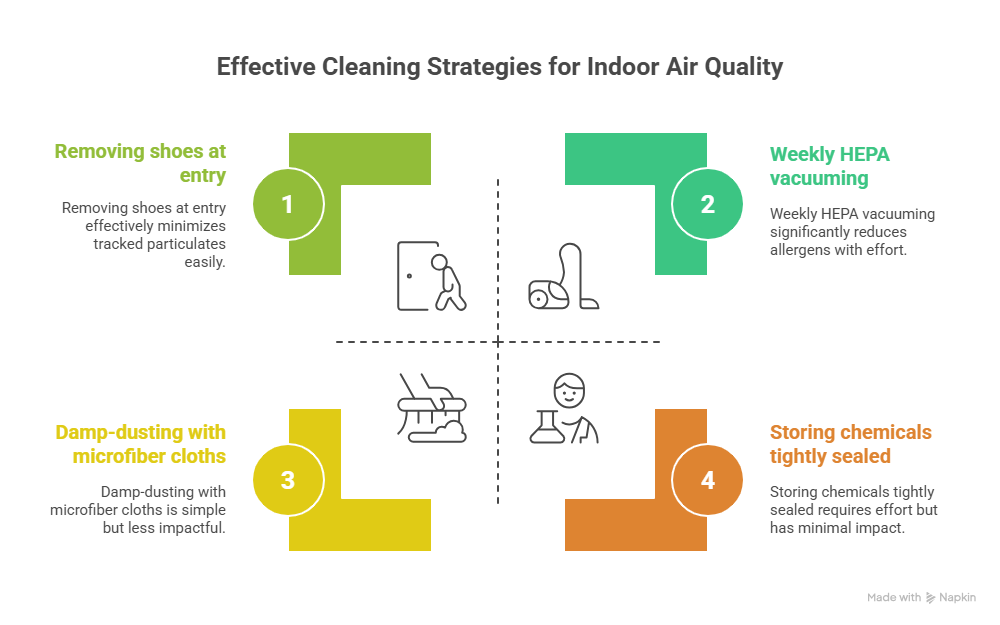
Small changes in cleaning technique greatly reduce indoor particle load, allergens, and residual toxins.
Use a HEPA-equipped vacuum (ASTM F3150 or equivalent performance) on carpets, rugs, and upholstered furniture at least weekly; vacuum slowly to improve particulate capture.
Damp-dust with microfiber cloths to avoid resuspending particles; rinse cloths frequently.
Wet-mop hard floors with a low-residue cleaner to limit VOCs.
Launder bedding weekly in hot water (≥130°F/54°C) to reduce dust mites.
Encase mattresses and pillows with allergen-impermeable covers (≥10 µm pore size).
Wash or freeze plush toys periodically.
Clean supply and return grilles, and vacuum baseboards where dust accumulates.
Remove shoes at entry to cut tracked particulates and lead dust.
Choose EPA Safer Choice or CARB-compliant low-VOC cleaning products.
Store chemicals tightly sealed, away from living spaces.
Create Healthier Daily Habits Indoors
Beyond smarter cleaning, your day-to-day routines shape indoor air quality hour by hour.
Prioritize source control: avoid burning candles or incense, and choose fragrance-free, low-VOC products verified by third-party labels.
Cook with back burners and run a vented range hood on high; if unvented, open a window briefly. Don’t idle cars in attached garages.
Maintain 40–50% relative humidity with a calibrated hygrometer; use a dehumidifier or humidifier as needed and replace wicks per manufacturer guidance.
Ventilate strategically: crack windows for 5–10 minutes after showers, cleaning, or cooking to dilute pollutants.
Change HVAC filters on schedule (MERV 11–13 if your system supports it) and keep vents unblocked.
Store solvents tightly sealed in detached areas.
Wash bedding hot weekly.
Remove shoes at entry.
Conclusion
You can keep winter air clean without sacrificing warmth. Balance ventilation with heat recovery, hold indoor humidity near 40–50%, and eliminate pollutants at the source—combustion, VOCs, and smoke. Service HRVs/ERVs, range hoods, and furnaces; replace MERV 11–13 filters per manufacturer guidance. Vacuum with a sealed HEPA, damp-dust, and launder textiles hot.
Choose low-VOC products and store chemicals safely. Test CO alarms, calibrate sensors, and follow local codes. Track results with a particle monitor to verify improvements.


.svg)

.jpg)
.jpg)
.jpg)