
How to Choose the Right Pillow for a Bedroom or Tiny Home

.jpg)
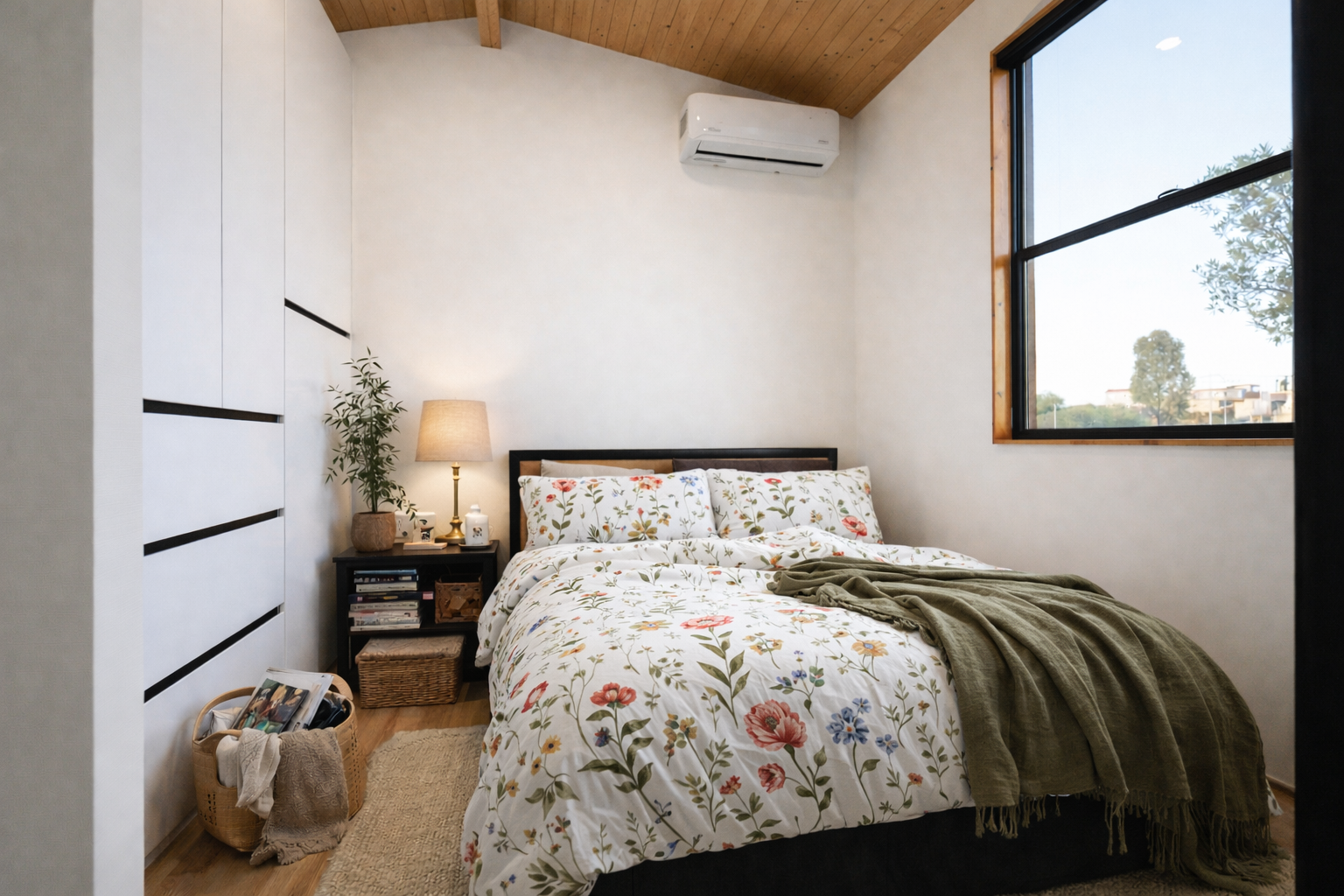
In a small bedroom every item has to prove that it is worth the space it takes. That is clear with furniture, storage and kitchen tools. It also applies to the bed.
A pillow may seem like a decision until you end up with three of them stacked in a corner because none feels just right. In a home the ones that do not work can be moved to a guest room or hidden in a closet. In a home they just become mess.
Choosing a pillow that actually works for the way you sleep is therefore worth a little thinking.
The usual labels. Soft, medium and firm. Are not very helpful on their own. A pillow can feel very soft in your hands. Still be too high for your sleeping position. Another can feel quite firm but compress to the right height when your head is on it.
The better starting point is to think about how the pillow will behave after hours not how it feels for the first few seconds.
Start with sleeping position, not softness
Side back and stomach sleepers usually need amounts of pillow height.
A side sleeper needs to fill the space created by the shoulder so a pillow that keeps some height under pressure is often more comfortable. A back sleeper usually needs height while stomach sleepers usually do better with something lower and softer.
These are not rules. Shoulder width, body size and mattress firmness all change the situation.
A soft mattress allows the body to sink further into the bed reducing the distance between the head and the bed. A firmer mattress keeps the body higher which might mean that a more pillow height is needed.
This is why replacing a mattress can suddenly make a comfortable pillow feel wrong.
It also explains why the measurements on the packaging do not tell the story. A pillow might measure six inches high when untouched but compress to half that once someone lies on it. What really matters is the height it maintains during use.
For anyone living in a space getting this right the first time is especially useful. There is benefit in keeping an assortment of pillows just because each one is almost right.

The filling is part of the story
Pillows are often sold based on what is inside them: memory foam, latex, fiber, feather or down.
Those materials do behave differently. The filling alone does not tell you how the pillow will feel over an entire night.
Memory foam tends to shape around the head and usually creates a more stable feeling. Fiber feels lighter and more traditional. Some fillings flatten more quickly than others. Latex usually bounces back faster. Tends to feel more light and bouncy.
Then there are hybrid types that use more than one material or have a separate internal support system.
That is useful because a pillow has than one job. It needs to feel comfortable on top. It also has to keep enough structure underneath.
Some newer designs separate these functions of expecting one material to do everything. Pocket-spring pillows for example place coils inside the pillow so the internal support can respond to pressure while foam or fiber provides the surface feel.
You do not need a complicated pillow just because it exists. The important thing is understanding what creates the support.
A helpful way to compare pillows for sleep needs is to look beyond the main filling and consider height, adjustability, ventilation and internal construction at the same time.
That gives you more useful information than a simple "medium firmness" label.
Adjustable pillows make sense in small homes
An adjustable pillow can be a good option when space is limited.
Of buying one pillow for side sleeping another because the first is too tall and eventually a third because the second is too soft the amount of filling can be changed until the height feels right.
This is especially useful for couples moving into a home. Two people may sleep on the mattress but need very different pillow shapes.
Adjustability also becomes useful after changing mattresses. If the new mattress is softer or firmer the pillow height can sometimes be adjusted than replaced completely.
There is a trade-off. Adjustable pillows tend to require a trial and error and removing too much fill can change the way the material distributes inside the cover.. In a home where every drawer and storage bench is important one adaptable pillow can be better than keeping several alternatives.
Think about heat in loft bedrooms
Temperature deserves extra attention in small homes.
Many tiny houses use a loft for sleeping and warm air rises. With good insulation and ventilation the sleeping area can feel warmer than the space below.
That makes pillow construction relevant in a way that might be less noticeable in a air-conditioned bedroom.
A cool-touch cover can feel nice when you first lie down. The inside of the pillow also matters. Dense materials leave space for air to move while perforated foams, breathable fibers and more open internal structures can let heat move more easily.
The same applies to the pillowcase.
Cotton, linen, lyocell and silk all handle heat and moisture differently. The best choice depends on preference, weather and the rest of the bedding.
The key is to think about the pillow as part of the sleeping environment.
If the loft runs warm adding a dense pillow under heavy bedding may make the problem worse. If the room is naturally cool the difference may barely be noticeable.
There is no cooling pillow" that works independently of everything else.
The pillow and mattress have to work
It is easy to shop for pillows as if they were completely separate from the mattress but the two surfaces interact.
Imagine a side sleeper lying on a mattress. The shoulder stays relatively high because it does not sink deeply into the bed so the pillow has to fill a gap.
Put the sleeper on a much softer mattress and the shoulder drops further into the surface. The gap becomes smaller.
The pillow that worked perfectly on the mattress may suddenly feel too tall on the second.
This is also why copying another persons pillow choice rarely works. Two people can have the sleeping position but different body sizes, different mattresses and completely different preferences.
A better approach is to notice what your body is already telling you.
If you constantly fold the pillow in half it may not be high enough.
If you regularly push it away during the night it may be too tall or too warm.
If you put a hand under your head you may be unconsciously adding the height the pillow's missing.
These small habits are often more informative than the details on the product page.
Do not assume more technology means a better pillow
Pillows have become technical products.
There are cooling gels, ventilation channels, contour shapes, phase-change materials, memory foams, removable inserts and internal spring systems.
Some of these ideas are genuinely helpful. Others solve problems that a particular sleeper may not have.
A person who sleeps comfortably on a fiber pillow does not need to replace it because a more elaborate design exists.
The best technology is often the technology you stop noticing.
If an internal structure helps the pillow hold its shape you should not spend the night thinking about that structure. If a breathable cover helps with temperature the result should simply be a comfortable sleeping surface.
The question should always be: what problem is this feature solving for me?
That approach is especially suitable in a home, where products tend to work best when they have a clear purpose instead of collecting features for no reason.
Pay attention to maintenance
A pillow is used for hours every night, cleaning and care matter.
Check whether the outer cover can be removed and washed. With foam pillows the inside core is often not machine washable so the removable cover becomes more important.
Fiber-filled pillows may be completely washable although drying them properly can take time.
In a home drying space can be limited so this is worth thinking about before choosing a large pillow that requires special care.
A good pillow protector can extend the life of the pillow. Is easier to wash frequently than the pillow itself.
It also makes sense to check whether the materials need reshaping. Loose fiber and feather pillows generally need fluffing than molded foam or structured designs.
None of these things is a reason to reject a design. They are simply part of living with it.
One good pillow is better than a pile of right ones
Small-space living tends to encourage a useful kind of discipline.
The dining table may also be a desk. A staircase can double as storage. A bench often needs to do more than just provide somewhere to sit.
The goal is not to make every item do five jobs. It is to choose things that do their job well enough that you do not need extra options.
A pillow fits that idea well.
Of collecting several inexpensive pillows and rotating between them it can make more sense to spend a little more time figuring out what you really need: the right height, the right level of compression, suitable materials and enough airflow for the room.
Price does not necessarily mean quality. An expensive pillow can still be wrong for you while a simple one can be exactly right.
What matters is whether there is a reason behind the construction and whether that construction suits your sleep.
Give a pillow a fair test
It is also worth avoiding a decision after a single night.
A new pillow can feel strange simply because the height or material is different, from what your body's used to.
That does not mean forcing yourself to sleep on something for weeks.. If the pillow seems roughly right a few nights usually provide more useful information than a five-minute test.
Notice whether you wake up moving it around. Pay attention to whether the height seems to change during the night. Think about whether you feel too warm whether the pillow bunches, under the head or whether you keep adding an arm underneath it.
Those observations tell you what needs to change.
In cases the problem is not that the pillow is "bad." It is that its height, material or construction does not match the sleeper.
Choose for the space you actually live in
A bedroom does not require a special category of pillow.
It simply makes good choices more valuable.
The limited storage encourages you to avoid products that do not work. Loft bedrooms make temperature. Airflow more noticeable. Multi-purpose spaces reward bedding that's easy to maintain and does not require a cupboard full of alternatives.
The same basic principles apply whether the bed sits in a 300-foot tiny house or a conventional home.
Start with sleeping position. Consider the mattress underneath you. Look at the height the pillow maintains once compressed. Think about airflow if the room gets warm and choose adjustability if you are unsure what profile suits you.
Importantly do not buy a pillow based only on how soft it feels in your hands.
It has a harder job to do once you fall asleep.


.svg)


.jpg)