Tiny Home Office Nook Ideas That Don't Eat Your Living Space


If you've ever tried to work from your kitchen counter with a coffee mug nudging your elbow and yesterday's mail competing for desk space, you already understand the problem. The modern remote worker faces a peculiar challenge: the home is supposed to be a place of rest, but the office now lives inside it, often without a room of its own.
This isn't a niche struggle. As of 2023, nearly 13% of full-time employees in the United States work entirely from home, with another 28% operating on hybrid schedules have held remarkably stable since the post-pandemic reset of the workplace. For most of these workers, the "home office" is not a dedicated room with a closing door. It's a corner of the bedroom, a stretch of kitchen table, or an alcove that nobody had a use for until Zoom calls started requiring a presentable background.
After years of covering home décor and small-space design and spending a fair amount of time crammed into corners ourselves, one thing becomes clear again and again: the best home office solutions are the ones that work with a space's existing architecture rather than fighting against it. Awkward corners, underused alcoves, hallway walls, stair cavities, these are not problems. They are opportunities. The ideas below are practical, grounded in how real people actually live, and designed to give you a functioning workspace without letting it consume the room around it.
1. The Fold-Down Wall Desk
Perhaps the most space-efficient option available, a fold-down wall desk, sometimes called a Murphy desk, mounts flush to the wall and drops open only when you need it. When closed, it looks like a cabinet or a decorative panel. When open, it gives you a clean, dedicated surface for your laptop, notebook, or monitor setup. When the workday ends, it folds flat and the room goes back to being a room.
Placement is everything here. Choose a wall near an outlet, ideally with some access to natural light, not just for aesthetics, but for your health. Research published in the Harvard Business Review, drawing on the "Employee Experience" survey of over 1,600 North American workers conducted by Future Workplace, found that employees with access to natural daylight reported a 51% drop in eyestrain, a 63% reduction in headaches, and a 56% reduction in drowsiness compared to those working under artificial light alone. A fold-down desk positioned near a window captures some of that benefit without committing to a permanent structure.
A few floating shelves directly above the desk surface with holding a small lamp, a plant, and the supplies you reach for most keep the wall looking intentional when the desk is folded up. This is one of the few setups that looks genuinely finished in both its open and closed states.
2. The Closet Conversion ("Cloffice")
If you have a closet you're not fully using or one you're willing to reorganize, converting it into a compact office nook is one of the most effective transformations available in small-space design. The concept, which has earned the nickname "cloffice," addresses two problems at once: it gives you a defined workspace, and it lets you close the doors at the end of the day, creating a physical and psychological boundary between work and rest.
That boundary matters more than it might seem. Research cited by psychologists studying remote work patterns has consistently found that the absence of a clear physical separation between work and home is one of the primary drivers of "work-life blending" a state where work demands quietly encroach on personal time, contributing to chronic stress and burnout. A closet with closing doors enforces that separation without requiring any conscious effort each evening.
The execution is straightforward. Remove the hanging rod, install a desk surface at counter height, add a few shelves above it, and run a power strip to the back wall. A pegboard mounted on the back panel makes a practical organizer supplies hang within easy reach without eating into desk space. A compact task lamp, a monitor riser, and a slim chair complete the setup. When the doors close, the office disappears. Tinyhouse.com's guide on organizing a small home office makes a point that applies directly here: bringing compact organizers and digital filing habits into the setup from day one prevents the slow paper creep that eventually makes even a well-designed closet nook feel chaotic.
3. The Vertical Wall Office
When floor space is genuinely scarce in a studio apartment, a single-room tiny home, or a densely shared open-plan space thinking vertically rather than horizontally opens up possibilities that a conventional desk simply cannot offer. A vertical wall office uses a narrow stretch of wall, typically between 18 and 24 inches wide, to create a fully functioning workstation with almost no floor footprint.
The components are deliberately minimal. A floating shelf at desk height just wide enough for a laptop and a notebook serves as the surface. A monitor arm mounted directly to the wall holds the screen. Floating shelves above provide storage. A pegboard or magnetic panel handles notes, chargers, and frequently accessed items. A tall stool placed in front completes the station and slides away when not in use.
OSHA's computer workstation guidelines specify that hands, wrists, and forearms should remain straight and roughly parallel to the floor during keyboard use, with elbows close to the body and bent between 90 and 120 degrees. A vertical wall office achieves this naturally because the setup is designed around one person in one position, there's no sprawl, no secondary surface pulling your posture off-center. Wall-mounted task lighting keeps the desk surface clear and helps define the space visually. This matters in a single room where the same four walls serve as living room, bedroom, and office: anything that helps the eye register "this is the work zone" supports the mental transition that makes working from home sustainable.
The team at Beloved Nook noting that workspace nooks function best when they lean on slim desks, wall-mounted organizers, and pegboards, not because these items are aesthetically fashionable, but because they're the specific tools that let a workspace coexist within a room without visually overrunning it. Pair that discipline with a calming color palette within the nook itself and what might look like improvised minimalism becomes something deliberate and genuinely livable.
4. The Window Alcove Workspace
If your home has a window alcove, a slightly recessed area framing a window. This is one of the most naturally appealing spots for a compact workspace. The light alone makes a compelling case. A study by Northwestern Medicine and the University of Illinois at Urbana-Champaign, published in the Journal of Clinical Sleep Medicine, found that office workers with windows slept an average of 46 minutes more per night than colleagues in windowless environments, a finding that underscores how much the quality of your working environment affects your life beyond working hours. Natural light, even through a modest window, regulates your circadian rhythm in ways that a desk lamp simply cannot.
The alcove also provides something that most small-space desks lack: a sense of enclosure. The walls on either side of the window create subtle visual definition, making the workspace feel like a place rather than just a surface.
A slim desk fitted to the alcove's width, a comfortable chair, and a task light for grey afternoons are all you need structurally. Narrow floating shelves on either side of the window hold books, a speaker, or trailing greenery without reducing light or making the space feel crowded.
5. The Under-Stair Office
Under-stair space is one of the most chronically wasted areas in a home. In many houses and split-level apartments, the triangular cavity beneath the staircase ends up as a loosely organized storage zone for shoes, bags, and things without another home. With some planning, it becomes one of the most characterful nook workspaces available partly because the geometry itself is interesting, and partly because it provides a feeling of genuine enclosure that few other setups match.
The diminishing ceiling height as you move deeper under the stairs is actually an asset once you design around it. Position the desk at the tallest point, where you sit, and use the lower-ceilinged back section for storage: file boxes, a compact printer, or a cable management tray. Built-in cabinetry makes the most of the irregular shape, but a well-chosen freestanding desk paired with a few open shelves works effectively for renters.
Kelly Pesanelli, a physical therapist and senior lecturer at Boston University whose work focuses on occupational injury prevention, has pointed out that one of the most common remote work mistakes is failing to configure a workspace properly before the day begins, improvising from a rushed setup five minutes before the first call. The under-stair nook benefits especially from upfront thought: once built in, it's less forgiving of afterthoughts than a desk you can freely rearrange. Creating a tiny home office requires understanding your own working style, how much visual separation you need, how much storage and how often you move between tasks.
.jpg)
6. The Corner Desk Setup
Corners are almost always underutilized in small rooms. A corner desk whether L-shaped, triangular, or a straight desk angled diagonally uses the room's footprint more efficiently than a desk pushed flat against a single wall, because it occupies space that would otherwise remain empty and contribute nothing.
The visual effect is also gentler. Because a corner setup doesn't project outward into the living area, it tends to feel more embedded than imposed, more like a feature of the room than an intrusion into it. Pair it with wall-mounted shelves rather than a large hutch, and the workspace stays light and visually open even in a small room.
From an ergonomics standpoint, a corner desk offers more practical benefit than it first appears. Cornell University's CUErgo laboratory, which has studied computer workstation design for decades under Professor Alan Hedge, recommends that your monitor, keyboard, and primary work surface be aligned along your body's midline and a corner configuration makes it easier to arrange secondary tools on an adjacent surface without creating awkward reaching angles. As CUErgo's guidelines note, overreaching to frequently used items is one of the most consistent contributors to shoulder and wrist strain over time, and a corner layout naturally reduces that distance for anyone working with more than one surface or tool at once.
For renters, a flat-pack L-shaped desk unit offers most of these benefits without permanent installation. For those who can go further, a built-in corner desk with integrated cabinetry above and below provides generous storage without claiming a single additional square foot beyond what the corner already occupies.
7. The Bookshelf Desk Hack
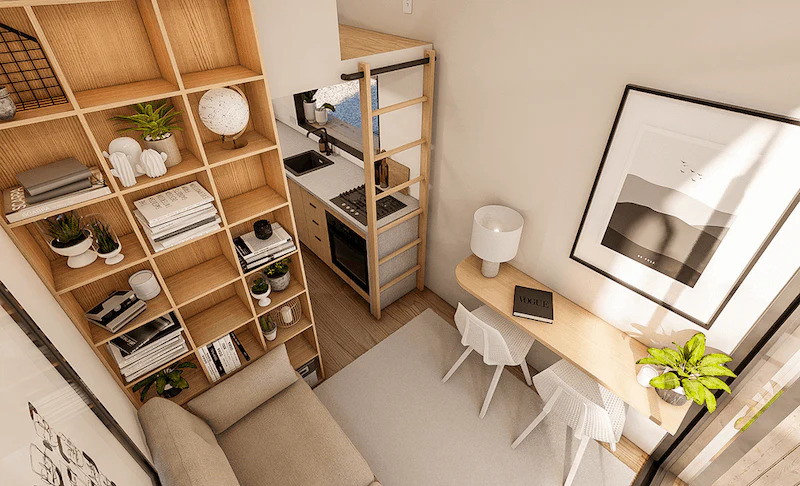
If you already own a large bookcase or a built-in shelving unit, one of its shelves may already sit at roughly desk height and that's an opportunity most people walk past without recognizing. This approach designates one mid-level shelf as a workspace, keeping the remaining shelves for books, décor, and storage. No additional furniture required; just a reframing of what you already have.
The execution is simple. Clear the chosen shelf, add a laptop riser or a small monitor stand, tuck a slim rolling caddy or narrow drawer unit beneath, and place a chair in front. The surrounding books and objects create a warm, library-adjacent working atmosphere that many people find genuinely conducive to concentration.
Herman Miller's ergonomics guidance for home office setup makes a point that applies directly here: your eyes should be level with the top third of your screen, your arms and wrists parallel to the floor while typing, and frequently used supplies kept within easy reach so you're not creating repetitive reaching motions throughout the day. All of these principles are achievable within a bookshelf setup, a monitor riser handles screen height, nearby shelves provide near-reach storage, and the slim footprint keeps the posture honest. Considering space-saving furniture ideas for tiny houses reinforces the broader point: the furniture you already own often has more functional range than you've been asking of it. A bookshelf is rarely just for books.
8. The Hallway Nook Desk
Hallways are the most overlooked surface in most homes. A hallway with even a modest wall stretch between two doors can accommodate a narrow floating desk, a slim stool, and wall-mounted shelving without meaningfully disrupting foot traffic provided the desk depth is kept genuinely modest.
Aim for around 10 to 14 inches of depth. That's enough for a laptop and a notebook in proper position, and won't turn a corridor into an obstacle course. A swing-arm wall sconce handles task lighting without occupying desk space. Shelves above provide storage. The overall footprint is small enough that the hallway stays a hallway.
There's also a quiet psychological advantage to working in a transitional space. A hallway is somewhere you move through with purpose, and that quality can carry into the working session itself. Sitting there tends to produce a focused, bounded mode that open desks in shared living rooms don't always generate in part because there are fewer ambient cues inviting you to relax, check the television, or drift into household tasks. Research on remote work and boundary management has consistently found that the physical and psychological cues that traditionally marked the end of a workday, leaving a building, a commute are largely absent when you work from home, and that creating deliberate spatial signals within the home itself is one of the more effective compensations. A hallway nook, small as it is, is still a signal: organizing a small home office help to create distinct zones within a compact home genuinely supports the mental shift between work time and rest time, even when those zones are defined by a floating shelf rather than a wall.
A Final Word on Making It Work Long-Term
Regardless of which of these setups fits your home, a few principles hold across all of them. Good lighting (natural where available) and a proper task light for everything else is non-negotiable for sustained focus and physical comfort. The Northwestern Medicine research is worth repeating here: access to daylight doesn't just help you see better at your desk; it improves your sleep, your alertness, and your mood in ways that compound across weeks and months.
Finally, storage handled thoughtfully from the start prevents the slow accumulation of clutter that gradually makes a well-designed nook feel chaotic. The right nook, done with intention, isn't a compromise version of a proper home office. More often than not, it turns out to be the most focused spot in the house because its limits are also its strengths.


.svg)