Commercial Kitchen Appliances for Tiny House Builds

Tiny house builders running a hospitality use case (Airbnb rental, food-truck-style operation, or a primary residence with serious cooking) often hit the same gap on the appliance shortlist. Residential-grade compact appliances cover most casual use but struggle under the volume that comes with hospitality or daily cooking for a household above two people. Commercial-grade kitchen equipment fills the gap, and a growing number of compact commercial units now fit tiny house footprints.
Tiny house builders sourcing this category often start with Canadian and US commercial supply specialists. The Chef Stop team in Canada runs an online retail catalogue covering refrigeration, food preparation, cooking, and bar equipment in sizes from under-counter to mid-line commercial. The catalogue's filter system lets builders search by physical dimensions, which matters when the kitchen wall is 8 feet long.
Why Does Commercial-Grade Equipment Make Sense for Some Tiny Houses?
Three structural realities push some tiny house builds toward commercial-grade appliances. Each one matters more than the price premium.
Durability is the first. Commercial appliances are built for daily 12-hour duty cycles rather than the 2 to 4 hour residential pattern. The compressor on a commercial under-counter fridge runs roughly 3 times the cycles of the residential equivalent before failure. The build difference shows up clearly in tiny houses with frequent guests or owners who cook daily.
Capacity-per-footprint is the second. A 24-inch wide commercial under-counter prep refrigerator stores roughly twice the usable volume of a residential mini-fridge of the same external dimensions. The difference matters when the kitchen has only 6 to 10 linear feet of counter and cabinet space.
Power efficiency at sustained load is the third. Modern commercial equipment hits Energy Star ratings that often beat the residential equivalent. A tiny house running on a 30-amp shore connection or an off-grid solar system needs every watt of efficiency available.
What Should Tiny House Builders Verify Before Sourcing?
Six criteria belong on every shortlist. The table below summarises the priorities.
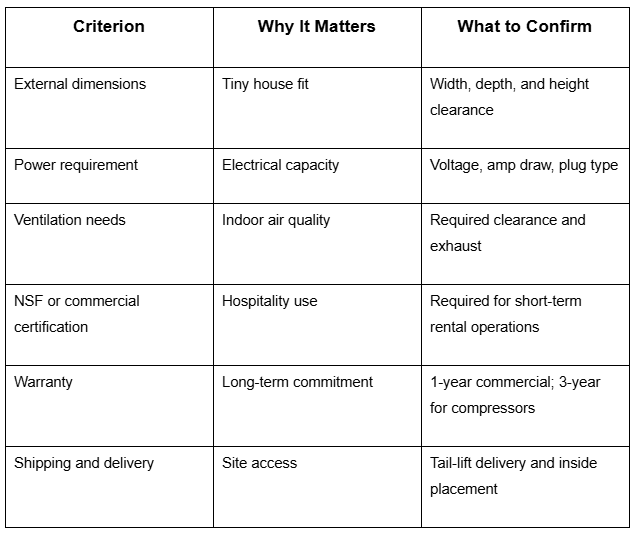
A vendor that gives clear answers across these six points signals a partner worth booking. A vendor that deflects on any signals friction ahead. Coverage of the best space-saving appliances for tiny house kitchens reminds readers that the residential side covers most casual cases. The commercial path opens for builders with specific use cases.
Which Appliances Earn the Commercial Upgrade Most Often?
Three categories show the biggest commercial-versus-residential gap.
Refrigeration is the most common upgrade. A 24-inch under-counter commercial fridge typically lasts 12 to 18 years against the residential 4 to 8 year average. The longevity math favours the commercial pick across most tiny house build horizons.
Cooking equipment is the second category. Commercial induction cooktops handle continuous use without the cycling protection that residential cooktops impose. The faster heat-up and recovery times also reduce the energy bill on off-grid systems.
Dishwashing is the third category. Commercial under-counter dishwashers run 90-second to 3-minute cycles compared with the 60-to-120-minute residential cycle. The faster turnaround matters in short-term rental operations where back-to-back guest stays compress the cleaning window.
.png)
What Errors Surface in Tiny House Commercial Appliance Buying?
Several errors recur:
- Skipping the physical dimension check which leaves the appliance unable to fit through the doorway
- Forgetting the ventilation requirement for commercial cooktops and dishwashers
- Choosing on price alone without modelling the 15-year durability difference
- Ignoring the power draw which can trip the tiny house breaker panel
- Treating commercial certification as optional when short-term rental operations require it
The US ENERGY STAR's commercial food service guide covers the energy-efficiency framework tiny house builders should reference. Coverage of how to personalise your tiny house design reminds readers that the kitchen often anchors the home's character across daily use.
Quick Reference: Commercial vs Residential Cost-Per-Year
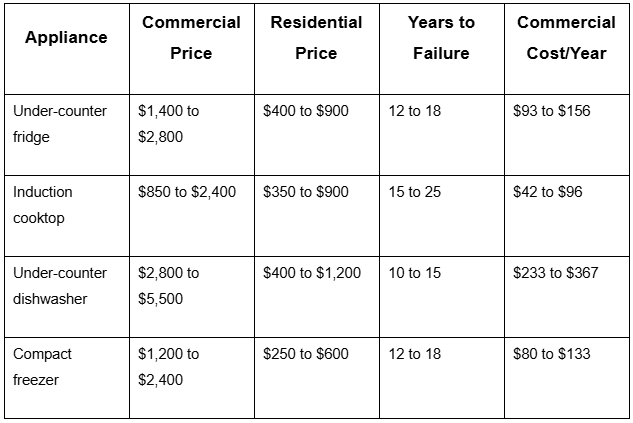
The residential equivalents typically need replacement 2 to 3 times across the commercial appliance's service life. The lifecycle math often favours commercial for tiny house builds with serious cooking use.
Pre-Order Checklist for Tiny House Builders
- Measure the appliance footprint twice against the kitchen layout
- Confirm power voltage and amp draw against the tiny house panel capacity
- Map the ventilation requirements for any cooking or dishwashing equipment
- Verify commercial certification if the tiny house runs short-term rentals
- Plan the delivery route through any narrow doors or stairs
- Confirm warranty terms before paying the deposit
The Bottom Line for Tiny House Builders
Commercial-grade kitchen equipment makes sense for tiny house builds with serious cooking use, short-term rental operations, or off-grid power constraints. The price premium pays back across the appliance's service life, and the durability difference shows up clearly in daily use.
A tiny house builder who runs the six-criteria shortlist once usually keeps the same commercial appliances across 15 to 20 years of operation. The US Department of Energy's home appliance efficiency hub covers the broader efficiency framework builders should reference for the wider build planning.
Frequently Asked Questions
Do Commercial Appliances Need Special Electrical Work in a Tiny House?
Some do, especially induction cooktops and commercial dishwashers that often need 220V or higher amp circuits. Most commercial under-counter refrigerators run on standard 120V 15-amp circuits. Always confirm the spec sheet against the tiny house electrical panel.
Is Commercial Equipment Louder Than Residential?
Often yes. Commercial compressors typically run 6 to 12 decibels louder than the residential equivalents. The trade-off matters more in tiny houses where the kitchen sits within 10 feet of the sleeping area. Some builders mitigate with acoustic insulation around the refrigeration cabinet.
Will Commercial Appliances Fit Through a Standard Tiny House Door?
Most under-counter and compact commercial appliances fit through a 30-inch door, but always verify the exact dimensions. The shipping crate often adds 2 to 4 inches on every side. Plan to remove handles, doors, or shelving for the entry move if the clearance is tight.
Do Short-Term Rental Operations Require Commercial-Grade Appliances?
In some jurisdictions, yes. Many North American municipalities require commercial or NSF certification for any property serving food to paying guests. Always check the local short-term rental regulations before committing to residential equipment.


.svg)
.jpg)