What Affects the Cost for Replacement Windows in Tiny Homes and Small Houses?

.webp)
The price of replacement windows for tiny homes is influenced by five main factors: window size, frame material, the type of glass, if the opening is standard or custom, and the labor installation difficulty. Although a tiny home might have fewer windows than a regular house, the cost per window might be more expensive as installers still have to consider travel, setup, disposal, trim, sealing, and minimum-job costs.
If one owner is comparing different local quotations, it is useful to get the factory price of the window unit only. For instance, a small house in Idaho may have better cold weather performance, flashed carefully, and airtight sealing is required. That is why a local search such as windows replacement Boise can be useful when the goal is to compare climate-aware installation rather than a generic product price.
What affects the cost for replacement windows in tiny homes most?
The first cost driver is the number of windows, but the second is the installer’s minimum project cost. In a house that is 2, 000-square-foot, changing 12 windows distributes the elements such as traveling, measuring, hauling, and cleanup over a bigger bill. In a tiny house of 280-square-foot with four windows, the very same tasks that are fixed will fall on fewer units.
Here is a realistic pricing lens
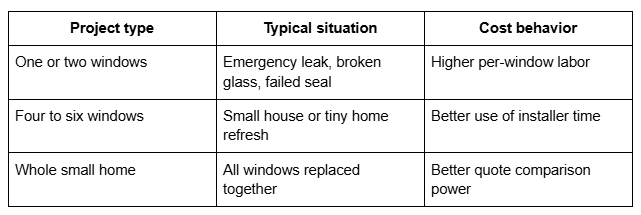
A practical mini-calculation: if a contractor has $350 in fixed trip, setup, disposal, and admin costs, that adds $87.50 per window on a four-window project. On a ten-window project, it adds $35 per window. This is why the cost for replacement windows for Tampa homeowners can feel high even when the actual window units are small.
How small house window replacement cost changes by material
Choosing materials for tiny homes, vinyl or fiberglass are usually the best-value options. While vinyl helps keep the price low, on the other hand fiberglass can cope better with temperature changes and works with less expansion. Wood is the top choice in terms of appearance especially for cabins and small houses with a cottage style, however it will require more maintenance due to moisture, condensation, and movement due to the changing seasons.
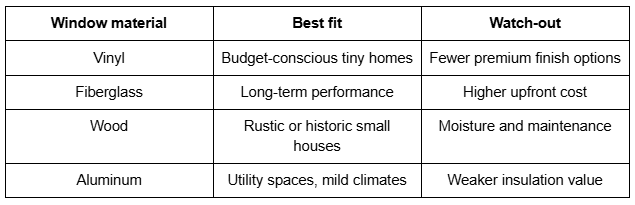
How energy efficiency affects replacement windows for tiny homes
Energy efficiency counts way more in a tiny home than many owners think. A small space changes very fast: just one single drafty window can make a sleeping loft cold, overheat a desk area, or lead a mini-split to cycle more often.
The Department of Energy defines the solar heat gain coefficient (SHGC) of a window as an indication of the amount of solar heat a window will let in. A low SHGC will be effective in cutting down the summer heat, and a high SHGC will be helpful in storing the winter heat. Air leakage ratings are important too, but the actual tightness of a building in a real situation is pretty much the result of a proper installation.
For tiny homes and small houses, consider:
- Low U-factor glass for cold or mixed climates.
- Low-E coatings for better comfort near glass.
- Double-pane glass as the practical baseline.
- Triple-pane glass only when climate, noise, or comfort goals justify the added cost.
- Lower SHGC on west-facing windows that overheat in summer.
This is where cost for replacement windows in tiny homes should be judged by comfort per square foot, not price per window alone.
What glass type affects the cost in tiny house window replacement?
Type of glass can affect the price even more than the size of the frame. For instance, a small casement window with only double-pane glass usually isn't a big money concern. However, the identical window with tempered glass, obscure glass, laminated glass, triple-pane construction, argon fill, or special coatings will be significantly more expensive.
Tiny houses often need tempered glass in tight locations, loft areas, doors, bathrooms, and windows close to walking surfaces. That requirement is not a design upgrade; it is often tied to safety rules. Custom privacy glass in a bathroom or egress-compliant glass near a sleeping area can also raise the final invoice.
A useful decision filter
- Choose standard double-pane Low-E glass for everyday windows.
- Upgrade only the hot, cold, noisy, or privacy-sensitive openings.
- Ask whether tempered glass is required before approving the quote.
- Compare comfort value, not just product price.
- Avoid premium glass where shade, curtains, or exterior awnings solve the same problem.
When custom windows raise the cost for small houses
Custom windows are a staple in tiny homes, mainly because the architects usually design irregular wall configurations, lofts, slim kitchens, small bathrooms, and the dimensions which are mostly based on the trailers besides the other standard ones.
Stock windows usually cost less because they fit common openings. Custom windows cost more because the unit may be made to order, and the installer has less room for adjustment. The risk is even higher when an old opening is out of square. In a tiny home, a quarter-inch problem is not minor if the wall assembly is thin and the trim space is limited.
A real-world “what went wrong” example: a homeowner orders a custom awning window based on the visible glass size, not the rough opening. The unit arrives too small, the installer has to rebuild the opening, and the project gains extra labor, foam, flashing, trim, and delay costs. The better move is to have the installer measure before ordering.
How installation labor affects the final cost
Installation labor depends on access, wall type, trim, siding, height, weatherproofing, and whether the job is retrofit or full-frame. HomeAdvisor notes that retrofit installation is less labor-intensive when the existing frame is sound, while full-frame replacement costs more because it replaces the frame and allows inspection for damage. It also lists labor ranges of $100–$300 for retrofit work and $150–$800 for full-frame work.
Tiny homes add their own labor issues:
- Trailer-based homes may move slightly, so sealing must handle vibration.
- Thin wall assemblies leave less room for insulation and flashing errors.
- Metal siding, cedar cladding, or custom trim can slow the job.
- Loft windows may need careful interior access.
- Small bathrooms may require privacy glass, tempered glass, and moisture-resistant trim.
Installation is the wrong place to chase the lowest bid. A poorly sealed window can create hidden water damage, mold, soft trim, and higher heating or cooling costs.
How to estimate the cost before replacing windows in a small house
Use a simple worksheet before asking for quotes. It keeps the conversation focused and makes bids easier to compare.
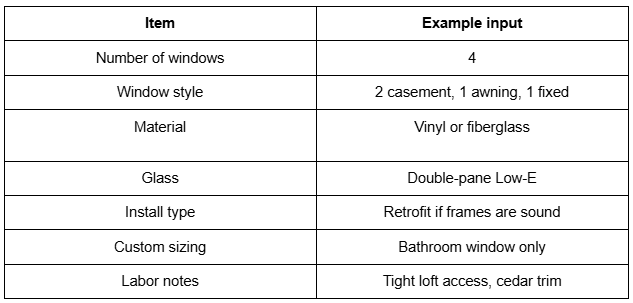
If you have a tiny home with four standard vinyl replacement windows and the frames are intact, the price could range from moderate. But throw in custom sizes, fiberglass, full-frame, tempered glass or siding repair and it can quickly jump. For this reason, tiny home window replacement costs should begin with a survey, not an online estimate.
How to avoid surprise costs
It's not all about size when it comes to windows for tiny homes. Tiny homes require size, material, window glass selection and installation. The most competitive quote is not the lowest price, but the quote that most accurately describes what it all includes, what will be different after the existing windows are gone and how the installer will keep water from getting into the wall.
Planning can really pay off in a small project. For example, changing multiple windows simultaneously if you can, maintaining the majority of window sizes standard, only enhancing the glass for the locations that really need it from a comfort point of view, and even requesting a breakdown of the whole job in separate items. This way you'll have a more transparent budget and fewer surprises after the removal of the existing windows.


.svg)
.jpg)