
Downsizing Into a Tiny House: How to Plan the Move and Let Go of the Excess

.webp)
Tiny house living promises freedom from clutter, lower monthly costs, and a lighter footprint. Getting there, though, means solving a very physical problem first. You have to move out of a larger space and into a dramatically smaller one, and that transition is where most people underestimate the effort. The dream is the finished tiny home. The reality is the weeks beforehand spent deciding what comes with you and what stays behind.
This guide walks through how to approach a downsizing move methodically, so that by the time you arrive at your tiny house, everything that comes through the door actually belongs there.
Start With the Floor Plan, Not the Boxes
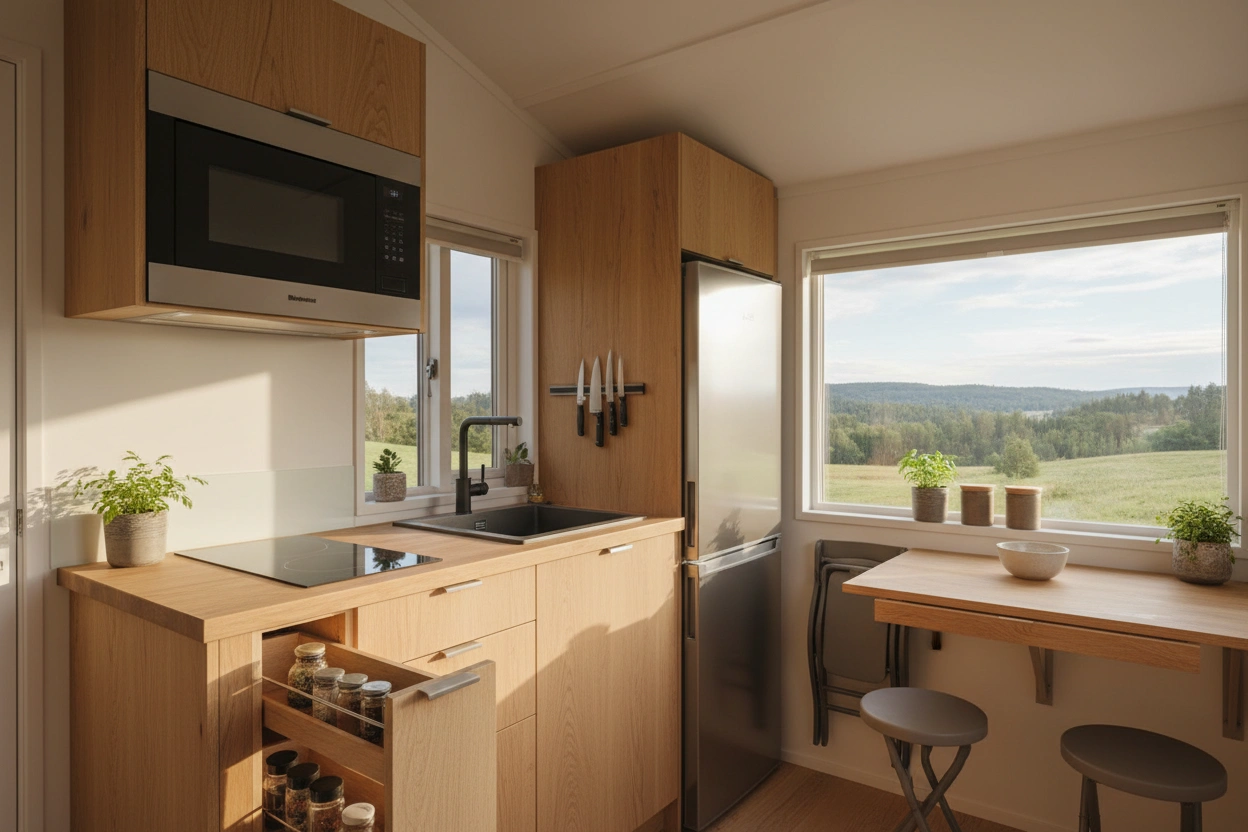
Most people begin a move by packing. When you are downsizing into a tiny house, that is backwards. Begin with the floor plan and the storage you will actually have: the loft, the under-stair drawers, the bench seating, the kitchen cabinets. Measure it. Write down roughly how many cubic feet of storage your new home offers, because that number is your real budget. Everything you own has to fit inside it or live somewhere else.
When you know your capacity first, every later decision gets easier. Instead of asking "do I love this," you ask "does this earn one of my limited shelves." That second question is far more honest, and it moves the process along quickly.
Use the Three-Pile Method
Work room by room in your current home and sort every item into three piles: keep, rehome, and store. Keep is for things that fit your new capacity and that you use regularly. Rehome covers what you will sell, donate, or give to friends. Store is the smallest pile and the most dangerous one, because a storage unit can quietly become a place where indecision lives forever.
A useful rule for the keep pile: if you have not used an item in a year and it is not seasonal or sentimental, it probably belongs in the rehome pile. Tiny house living rewards multi-use objects, so favor the cast-iron pan that does ten jobs over the single-purpose gadget that does one.

Be Honest About What a Small Space Holds
A tiny house is not a small apartment. Vertical space and dual-purpose furniture do a lot of the work, but there is a hard ceiling. Beds with drawers underneath, fold-down desks, nesting cookware, and a capsule wardrobe are not minimalist affectations in a tiny home. They are how the space functions day to day. If an item cannot fold, nest, stack, or serve more than one role, give it a hard look before it makes the cut.
Sentimental belongings deserve their own plan. You do not have to part with everything that carries memory. You do have to choose. Photograph the things you cannot keep, keep a small dedicated box for the few that matter most, and accept that the memory does not live in the object.
Make a Plan for the Overflow
Even a disciplined sort leaves things you are not ready to release. Furniture for a future move, tools, seasonal gear. For these, a small storage unit can be reasonable, but set a review date on the calendar. Storage that you never revisit is just delayed decision making with a monthly bill attached.
For everything in the rehome pile, start early. Selling takes longer than people expect, and donation centers often need appointments for larger items. Give yourself several weeks so the overflow does not turn into a last-minute pile you shove onto a truck out of panic.
Pack Smart, Not Heavy
Downsizing changes how you pack. You are moving fewer items, but you want them to arrive in good shape and to unpack fast in a space with no room for clutter. Label boxes by where they land in the tiny house, not by where they came from. A box marked "loft" or "kitchen upper cabinet" tells you and anyone helping you exactly where it goes. Use protective padding on the few fragile pieces you kept, and keep an essentials box with what you need for the first night so you are not opening every container to find a phone charger.
.webp)
Handle the Actual Move With Care
A tiny house move has its own quirks. Sometimes you are relocating belongings into a stationary tiny home on a foundation or in a community. Sometimes the tiny house itself is on a trailer and the move crosses state lines. Either way, the logistics deserve real planning rather than a rushed weekend with borrowed help.
If you hire professional movers for the transition, vet them the way you would vet any company touching everything you own. Check whether the company owns its trucks and employs its own crews, or whether it is a broker that books your belongings to a carrier you never chose. Look up the USDOT number on the federal FMCSA SAFER website before you sign anything. A carrier that owns its equipment and staffs its own crews stays accountable for the whole job, from the first box loaded to the last one placed.
Working with an asset-based carrier such as Ontrack Moving®, which owns its fleet and employs its crews across California and Arizona and handles relocations throughout the Western United States, means one company manages the move from origin to destination instead of transferring your belongings to a stranger partway through. Reputable movers also carry standard cargo liability of sixty cents per pound per article under federal rules, with additional valuation coverage available for purchase, so ask what protection applies before moving day rather than after.
Settle In Without Refilling the Space
The last risk in a downsizing move is the slow creep of stuff back into your life. You worked hard to get light. Protect it. Adopt a simple habit: when something new comes in, something old goes out. In a tiny house, that one rule does more to preserve your hard-won space than any organizing product on the market.
Downsizing into a tiny house is not really about getting rid of things. It is about deciding what your daily life actually needs and giving those things a proper home. Do the deciding before the move, plan the logistics with the same care you gave the design, and the tiny house you arrive at will feel like the fresh start you pictured, not a smaller version of the clutter you left.


.svg)

.jpg)