How Tiny House Trailers and Chassis Are Manufactured

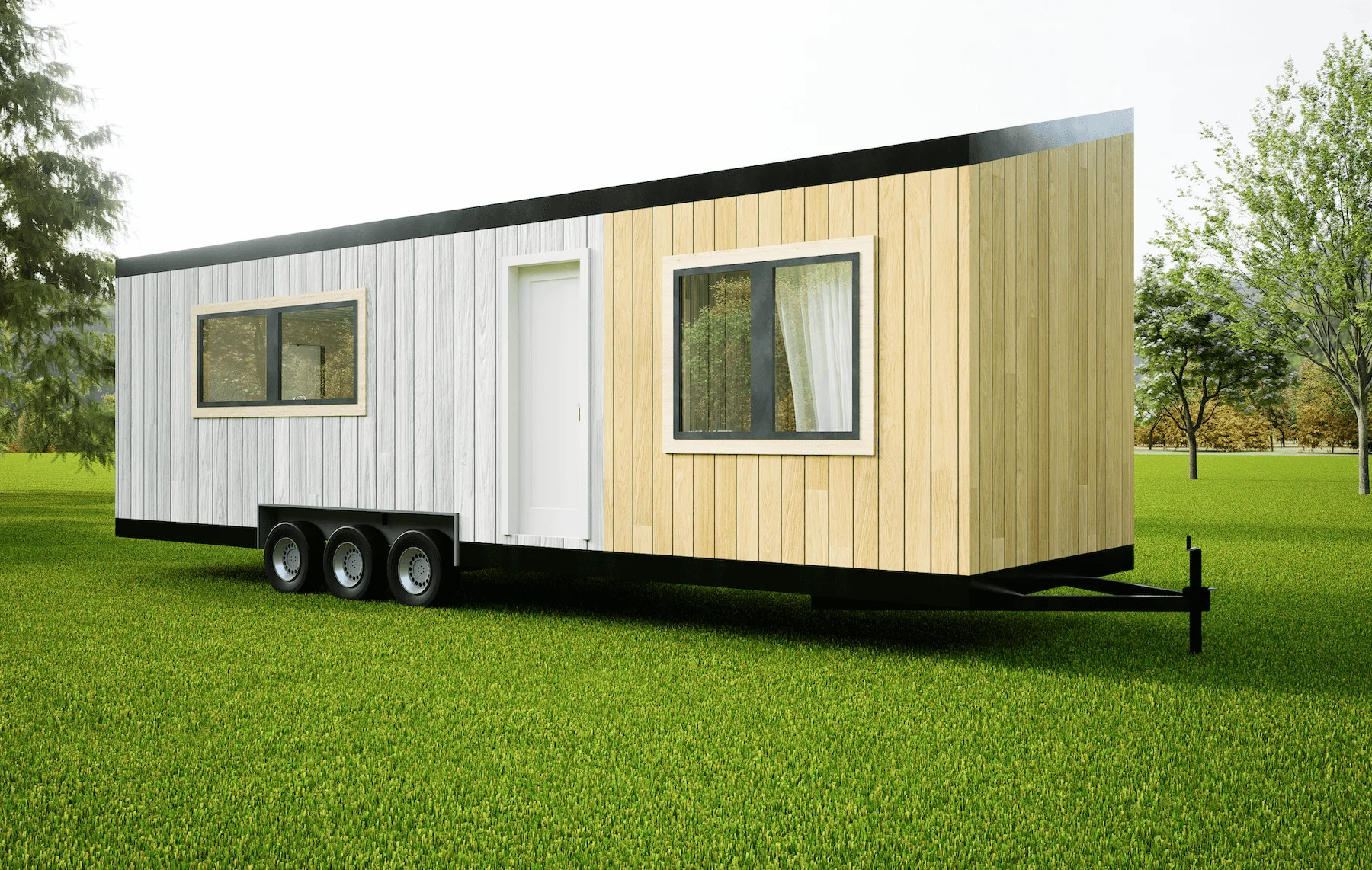
A tiny house might look like a conventional home in miniature, but its foundation has a different job. Instead of resting on permanent footings, a tiny house on wheels (THOW) relies on a steel trailer chassis to support it during transportation and while parked.
Manufacturing these trailers requires attention to structural strength, dimensional accuracy, weight distribution, and component quality. Even small fabrication errors can cause problems when the completed house is mounted onto the frame.
Building one custom trailer allows adjustments during production. Producing dozens of consistent chassis requires standardized designs, controlled welding, and documented inspections.
Anatomy of a Tiny House Trailer
A tiny house trailer is more than a flat steel platform with wheels. Its components work together to support the building, distribute loads, and maintain stability during transportation.
The main components include:
- Steel frame: Longitudinal rails, crossmembers, and reinforcements support the house.
- Axles and suspension: These carry axle loads and help manage movement over uneven roads.
- Braking system: Brakes, wiring, and applicable breakaway equipment help maintain control.
- Lighting and reflectors: These provide visibility and signaling for road use.
- Hitch and coupler: These connect the trailer to the towing vehicle and transfer towing forces.
- Leveling and stabilizing equipment: Jacks and supports help stabilize the structure when parked.
- Structural mounting points: These secure the house to the chassis and transfer loads between the building and frame.
These components operate as an integrated system. Incorrect axle positioning can affect weight distribution, while poorly aligned mounting points can complicate assembly.
A chassis must be engineered around the building’s layout, including permanent walls, appliances, plumbing, and other concentrated loads. The design must account for transportation loads and the intended support arrangement when parked.

From Custom Fabrication to Repeatable Trailer Production
Moving from individual trailer fabrication to larger production runs changes how manufacturers organize their workshops.
The process starts with standardized engineering drawings for frame dimensions, steel grades, material thicknesses, mounting locations, and assembly requirements. These specifications provide a consistent reference for each chassis in a production batch.
Structural steel is measured, cut, and prepared using equipment such as CNC plasma cutters, band saws, and drilling machinery. Computer-controlled cutting can improve consistency across repeated parts.
Welding jigs and fixtures hold rails and crossmembers in position, helping maintain alignment. Before permanent welding, workers check frame squareness, diagonal measurements, and axle mounting positions.
Documented assembly sequences and inspection checkpoints also help manufacturers identify recurring problems and reduce rework.
How Precision-Machined Components Support Chassis Manufacturing
Most tiny house trailer frames are fabricated from structural steel rather than machined from solid metal. Some custom hardware, however, may require precise dimensions. Depending on the design, parts can include pins, bushings, spacers, sleeves, and specialized jack hardware.
For recurring production runs, manufacturers can use industrial lathe machines to produce cylindrical parts such as sleeves and spacers. These components should be checked against their drawings using appropriate measuring instruments.
Safety-critical parts associated with braking, towing, suspension, or structural connections require engineering validation and should not be replaced with unapproved workshop-made alternatives.
Welding, Finishing, and Corrosion Protection
Once the structural components are prepared, welding and assembly become central to production. Gas metal arc welding, commonly called MIG welding, is one process used in steel trailer fabrication. The right procedure depends on the materials, joint design, and structural requirements.
Manufacturers must control welding parameters, joint preparation, and weld sequence. Excessive heat or poor sequencing can distort a frame and affect alignment. Completed welds and critical dimensions are inspected, with additional testing where specifications require it.
Corrosion protection should be considered during design. Two common finishing methods are:
- Hot-dip galvanizing: Steel is immersed in molten zinc to form a protective coating.
- Powder coating: Prepared surfaces are coated with powder and cured to create a durable finish.
Each method requires suitable preparation. Galvanizing may require vent and drain openings, dimensional allowances, and planning for distortion. Powder coating requires surface preparation, an appropriate coating system, and proper curing.
Before release, manufacturers check coating condition, alignment, fastener torque, and assembly completeness. Road-going trailers also need functional checks of lighting, brakes, and any fitted breakaway system.

Weight Ratings, Load Distribution, and Compliance
A tiny house trailer must carry more than an empty floor structure. The completed building may include kitchen equipment, water tanks, furniture, insulation, roofing, and utilities.
Gross Vehicle Weight Rating (GVWR) is the maximum loaded weight assigned to the trailer by its manufacturer, including the trailer itself and everything it carries. Gross Axle Weight Ratings (GAWRs) set maximum loads for individual axle systems. Axles, tires, wheels, and other components must meet the applicable design requirements.
Ratings should be checked against the completed tiny house in its transport condition, including water, batteries, furnishings, and personal contents. Verify total trailer weight, individual axle loads, and tongue or pin load using suitable weighing equipment. Staying below GVWR does not by itself confirm compliance with every axle, tire, wheel, hitch, or tow-vehicle limit.
Load placement matters, too. Heavy components placed too far forward or rearward can change tongue weight and towing behavior. Engineers need to consider axle placement, the completed structure’s center of gravity, and the intended towing arrangement.
In the United States, the National Highway Traffic Safety Administration (NHTSA) identifies federal requirements for trailer manufacturers, including vehicle identification numbers, applicable safety standards, tire and rim selection, and certification responsibilities. Manufacturers must also account for applicable state rules affecting registration, braking, and road use.
The National Organization of Alternative Housing (NOAH) provides a tiny-house dwelling standard and third-party inspections, including how the house is secured to its trailer.
NOAH certification does not replace applicable federal, state, or local requirements or automatically authorize residential placement or occupancy. Road-use compliance and permission to install and occupy a tiny house must be assessed separately.
Outsourcing vs. In-House Component Production
As production increases, manufacturers need to decide which components to make and which to purchase. Smaller fabrication businesses often buy axles, suspension assemblies, brakes, couplers, and other specialized components from established suppliers. This limits equipment investment and provides access to components designed for specific applications.
In-house production may make sense for frequently needed custom brackets, spacers, or fixtures. But machinery costs are only part of the calculation: manufacturers must also account for operator skills, tooling, setup time, inspection equipment, maintenance, waste, and scheduling.
The choice depends on the full cost of outsourcing versus in-house production, as well as whether the workforce can maintain the required accuracy and documentation. Safety-critical components are generally better sourced from qualified manufacturers unless the business has the engineering, testing, and quality systems to produce them appropriately.
Final Recommendations: Building Reliable Tiny House Trailers at Scale
Reliable production depends on sound engineering, standardized fabrication procedures, accurate component dimensions, consistent welding, and documented inspections. Corrosion protection and weight ratings also matter to the chassis’s long-term performance.
As production volumes increase, manufacturers should decide where in-house production provides value and where qualified suppliers offer better results. The aim is to improve efficiency through repeatable processes while maintaining structural integrity and towing safety.