Putting a Tiny House on Family Land: The Ownership Questions to Settle First

.jpg)
Building on land a relative already owns removes the largest single cost of tiny house living. It is the reason a great many tiny houses end up in a parent’s field, a sibling’s paddock or the far end of a family farm rather than on a plot bought outright.
What it does not remove is the question of who owns what. That question is easy to answer at the start, when everyone agrees and nothing has gone wrong, and extremely difficult to answer years later, when the circumstances that made the arrangement obvious have changed.
Ownership of the Land Comes First
The first thing worth establishing is who actually owns the land, which is often not what the family assumes.
Family land tends to carry history. A parcel may be registered in one parent’s name while both are treated as owners. It may still be in a grandparent’s name because an estate was never fully administered. It may be held jointly by siblings who inherited it together, in which case one sibling’s permission is not permission at all. Farm land in particular is frequently worked by people who do not appear anywhere on the title.
Where land is co-owned, every owner needs to agree. An arrangement made with one co-owner can be challenged by another, and the person who agreed to it may not be able to deliver what they promised.
Where the land is mortgaged, the lender’s consent may be required before anything is placed on it. Loan terms commonly restrict what an owner may do with the security, and stationing a dwelling on the land can fall within those restrictions. This is worth checking rather than assuming, because the consequences of breaching a loan condition fall on the landowner, who is usually the relative doing the favour.
Obtaining a copy of the title is straightforward in most jurisdictions and settles the question in an afternoon.
.jpg)
Whether the House Becomes Part of the Land
This is the question that decides most of the others, and it is the one people are most surprised by.
In common law systems, things attached to land can become part of it. Once that happens, they belong to whoever owns the land, regardless of who paid for them. Courts generally look at two things: how firmly the object is attached, and why it was attached in the first place. Something resting on the ground under its own weight usually remains the property of whoever brought it. Something fixed in place, particularly where the fixing suggests it was meant to stay, may not.
Applied to a tiny house, the practical markers are familiar ones. A house sitting on its trailer, with wheels attached and a tow hitch, looks like property that belongs to its owner. A house lifted off its trailer onto piers, decked around, skirted, plumbed into a septic system and wired into the mains starts to look like part of the land.
None of these individually decides the matter, and the answer is fact-specific enough that two similar arrangements can be treated differently. But the direction of travel is consistent: the more permanent the installation, the greater the risk that the structure has legally become the landowner’s property.
This matters because the person who built the house is rarely the person who owns the land. Someone who spends two years and their savings building a tiny house, then fixes it permanently to a parent’s field, may have made a gift they did not intend to make. The arrangement can also be set out in writing so that the structure remains the builder’s property whatever the physical position, which is a far simpler solution than arguing about piers afterwards.
Permission to Be There Is Not a Right to Stay
Family arrangements are usually permissions. Somebody says yes, the house arrives, and nothing further is said.
A bare permission of that kind is generally revocable. It can be withdrawn, often on reasonable notice, and it does not create an interest in the land. The person living there has considerably less protection than they tend to assume, and what protection exists usually depends on facts nobody recorded at the time.
An arrangement with more substance looks different. Where somebody occupies a defined area exclusively, for a defined period, typically in exchange for something, the arrangement may amount to a lease or tenancy rather than a permission. That carries greater security, and also greater formality, including obligations running in both directions.
There is a third possibility worth knowing about. Where somebody has been given a clear assurance, has relied on it, and has spent significant money or effort as a result, courts in several common law jurisdictions have sometimes granted relief even without a written agreement. That route exists, but it is a remedy for a dispute rather than a plan. It is slow, expensive, uncertain in outcome, and it requires suing a member of your own family.
What Happens If the Land Is Sold or Mortgaged
Circumstances change. A parent may need to release equity, downsize, fund care, or simply sell.
Whether an arrangement survives a sale generally depends on whether it was recorded in a way that binds a later owner. Informal permissions usually are not. A buyer who purchases land without notice of an arrangement is frequently entitled to treat the land as their own, which can leave an occupier with a claim against the relative who made the promise rather than any right to remain.
Mortgages raise the same issue from a different direction. A lender’s charge generally predates an arrangement made years later, and in a repossession the lender’s position is unlikely to be affected by a family understanding it knew nothing about.
Recording an interest properly, where the jurisdiction allows it, changes this materially. It is a modest piece of work at the outset and it is the difference between an arrangement that survives events and one that does not.
What Happens When the Landowner Dies
This is the scenario these arrangements most often fail in, partly because it is the one nobody wants to raise at the time.
When the landowner dies, the land passes under their will, or under intestacy rules where there is no will. It passes to whoever inherits it, which may be the person living on it, and may equally be a sibling, a spouse, or several people jointly.
If the tiny house has legally become part of the land, it passes with the land to the beneficiary. The person who built it may find themselves living in a structure that now belongs to a relative, with no written record of anything that was agreed and the one person who could confirm it no longer available.
Where several siblings inherit jointly, the land often has to be sold so the estate can be divided. A beneficiary who wants their share in money rather than land is entitled to it, and there is nothing unreasonable about that position. The result can still be a forced sale of the land somebody is living on.
The fix is not complicated and it is not confrontational. A landowner who intends somebody to remain can say so in their will, and the arrangement on the ground can be drafted to match. What causes difficulty is a will that says one thing and an informal understanding that assumed another.
If the Arrangement Ends
Arrangements also end for ordinary reasons. A relationship breaks down. A family falls out. Someone wants the land back for a use nobody anticipated.
Several questions then arrive at once. Who pays to move a structure that may no longer be roadworthy, or may never have been. Who bears the cost of the groundworks, the access track, the drainage and the service connections, all of which stay in the ground. Whether the person who paid for them can recover anything.
The general position is unhelpful to the person who spent the money. Improvements made to land somebody else owns are not usually recoverable simply because they were paid for, absent an agreement saying otherwise. The money is spent on an asset belonging to another party.
This is straightforward to address in advance and close to impossible to address afterwards, which is the pattern running through every question in this piece.
Putting It in Writing
None of this requires a complicated document. It requires a short one that answers the questions before they are live.
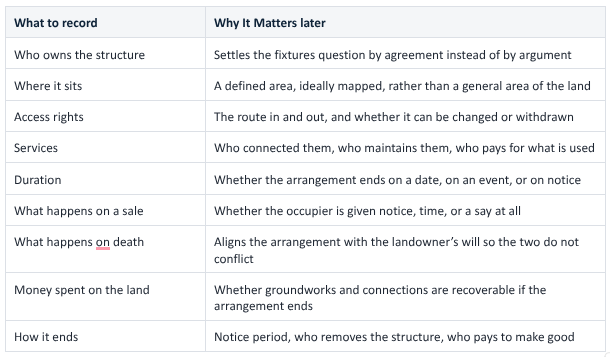
An agreement of this kind is not an act of distrust. It is a record of what everyone already agreed, made while everyone still agrees it and while the facts are fresh. The cost of drawing one up is a fraction of the cost of resolving the same questions once they are contested.
It also needs to be drawn up under the law where the land sits, because the rules on what binds a later owner, how interests are recorded and what happens on death vary considerably between jurisdictions. Someone placing a tiny house on family land in Ireland, for instance, is dealing with a registration system and succession rules that differ from those in England or in any US state.
Ronan Deasy, a Cork based solicitor, acts on family land transfers and sees the same sequence repeatedly:
“The difficulty is almost never at the start. Everyone is agreed, the parents are happy, nobody wants to make it formal because making it formal feels like distrust. It comes up years later, usually when the person who gave the permission has died or the land is being sold, and by then the only people who can say what was agreed are the ones who disagree about it. Half an hour and a written record at the outset would have settled every one of those questions.”
Ronan Deasy, Ronan Deasy Solicitors
Settle It Before the House Arrives
The questions in this piece are all cheap to answer before a tiny house is delivered and expensive to answer after. Establishing who owns the land, agreeing who owns the structure, recording where it sits and what happens if circumstances change are tasks measured in hours at the outset.
The same questions, raised for the first time during a probate, a sale or a family dispute, are measured in months and in legal costs, and they are resolved by people who were not present for the conversation that started it all.
Family generosity is what makes these arrangements possible. Writing them down is what makes them last.


.svg)
.jpg)