Specialty Moving for Design-Forward Homes: Pianos, Safes, and Antiques in the Twin Cities


Small homes can be beautifully designed, efficient, and full of character. But when it is time to move one heavy or delicate item, the size of the home can turn a simple task into a real logistics problem.
A piano in a compact living room, a gun safe in a lower level, an antique sideboard near a tight hallway, or a stone-top table in a small dining space all need more planning than a regular box or chair. The issue is not always the weight by itself. It is the combination of weight, angles, flooring, doorways, stairs, and fragile finishes.
In a design-forward home, every detail matters. Floors, trim, walls, stair rails, built-ins, and furniture surfaces all need to be protected. That is why specialty moving is not only for large estates or full-home relocations. Sometimes one piece is enough to require a specialty plan.
Small homes can make heavy-item moves more complex when pianos, safes, antiques, tight halls, and narrow stairs are involved.
Small Room, Big Object
A compact home can make movement harder because there is less room to adjust. A large item may fit inside the home, but that does not mean it can easily come out.
Movers have to think about doorway geometry, stair physics, weight distribution, and turning space. A heavy piece may need to be tilted, rotated, padded, or partially disassembled. A delicate item may need to be wrapped before it ever moves. A piano may require a piano board and the right crew setup. A safe may require controlled movement to prevent damage to the floor, stairs, and walls.
This is where specialty moving becomes different from regular lifting. It is not about forcing the item through the space. It is about reading the space before the item moves.
Why Heavy Items Need a Real Plan
Heavy pieces create more risk because once they start moving, they are harder to stop, redirect, or correct. That matters in tight hallways, loft stairs, older homes, and compact layouts.
Here are a few examples:
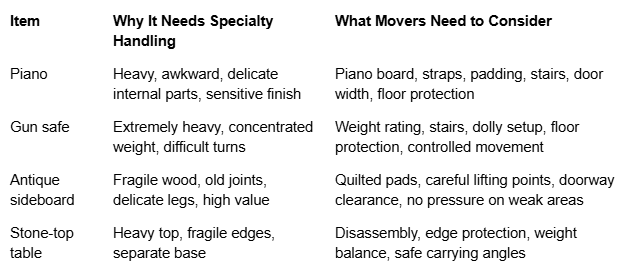
Each item creates its own challenge. A piano needs a different approach than a safe. A safe needs a different approach than an antique. A stone-top table may need the top separated before anything moves.
That is why a one-size-fits-all moving plan does not work for specialty items.
Doorway Geometry Matters
Doorways are one of the biggest issues in compact homes. A piece may look like it should fit, but the angle can change everything.
Movers often need to consider:
Door width
Door height
Hallway width
Ceiling height
Stair turns
Landing space
Furniture depth
Legs, handles, and trim
Nearby walls or built-ins
An antique cabinet may fit through the front door but not turn into the hallway. A piano may clear the doorway but not the stair landing. A safe may fit through the basement door but require special control on the stairs.
Before move day, homeowners should look at the full path, not just the room where the item sits. The path from the item to the truck matters just as much as the item itself.
.jpg)
Pianos Need More Than Strength
A piano is one of the clearest examples of why specialty moving exists. It is heavy, but it is also delicate. The finish can scratch. The legs can be vulnerable. The internal components need to stay protected. The weight is not always balanced in a way that makes casual lifting safe.
Depending on the type of piano and the layout of the home, movers may use a piano board, moving pads, straps, dollies, and coordinated lifting. If stairs are involved, the plan becomes even more important.
A piano in a small home may have limited space on every side. There may not be enough room to turn naturally, which means the crew has to plan the angle before moving. This is not the time to improvise.
Safes Are About Weight Control
A gun safe or heavy safe creates a different kind of challenge. Safes are often extremely heavy for their size, which means the weight is concentrated in one footprint. That can affect stairs, floors, thresholds, and how the item moves through tight areas.
The crew needs to understand:
How heavy is the safe
Where it is located
Whether stairs are involved
What kind of flooring is present
Whether the path has tight turns
Whether doors need to be removed
Whether the safe is going up or down
A safe on a dolly may look simple, but the wrong setup can damage flooring, walls, stair edges, or the item itself. Proper control matters from the first lift to final placement.
Antiques Need Protection Before Movement
Antique furniture requires a careful plan because older pieces may not respond well to pressure, twisting, or improper lifting. Legs, joints, veneers, drawer slides, glass, mirrors, and decorative details can all be vulnerable.
An antique sideboard, cabinet, desk, or armoire should be padded and handled with respect for how it was built. The goal is not only to avoid scratches. The goal is to avoid stress on weak points.
Quilted pads, careful wrapping, and clear communication all matter. If the homeowner knows a piece has a loose leg, a fragile drawer, an old repair, or a weak panel, they should mention it before the move begins.
When One Piece Is Enough
Some homeowners do not need a full moving crew for the whole house. They may only need help with one heavy piece. That can still be a valid specialty move.
Examples include:
Moving a piano from one room to another
Taking a safe to a basement
Moving an antique cabinet upstairs
Relocating a heavy table after remodeling
Moving one oversized piece into storage
Picking up one piece from a seller
Placing a designer item after delivery
For situations like that, homeowners may not need a full-home relocation. They may need movers for one piece of furniture who can handle the item safely without treating it like a basic delivery.
When It Becomes Specialty Moving
A move becomes specialty work when the item, the home, or the path requires more care than a standard carry.
That can include:
Heavy weight
Fragile materials
High-value furniture
Tight hallways
Loft stairs
Historic finishes
Delicate flooring
Oversized dimensions
Difficult turns
Items that need special equipment
In these situations, it is worth using single-item and specialty move help rather than assuming any crew can figure it out on arrival.
Specialty moving is about planning before lifting. The crew should understand what is being moved, where it is going, what the path looks like, and what protection is needed.
.jpg)
How Homeowners Can Prepare
Before scheduling a specialty item move, homeowners should gather details that help the mover plan accurately.
Helpful information includes:
What the item is
Approximate size and weight
Current room and final room
Number of stairs
Photos of the item
Photos of stairways and doorways
Type of flooring
Any fragile parts
Whether disassembly is possible
Any parking or building access issues
Photos are especially useful because they show things that are hard to explain over the phone. A tight turn, narrow hallway, low ceiling, or steep stairwell can change the plan.
The homeowner should also clear the path before the crew arrives. Remove rugs, small furniture, décor, plants, and anything that could block movement. If pets or children are present, they should be kept away from the moving path for safety.
Good Design Deserves Careful Handling
Design-forward homes often have pieces that were chosen carefully. A piano, antique sideboard, safe, stone table, or custom furniture piece may hold financial value, personal value, or both.
Moving those items is not only about muscle. It is about judgment. The crew has to understand the item, the space, the materials, and the risk points.
In compact Twin Cities homes, that matters even more. Tight halls, small entries, loft stairs, older layouts, and carefully finished interiors can turn one item into a project that needs real planning.
A smooth specialty move starts before anything is lifted. Measure the path. Share the details. Protect the home. Use the right equipment. And make sure the plan fits the piece, not just the room it is sitting in.


.svg)
.jpg)