
Key Factors to Consider When Hiring a Steel Fabrication Company

.jpg)
Whether the job goes to Metro Steel or another established workshop, hiring a fabricator is a decision that keeps showing up long after the contract is signed. It affects when the frame goes up, how the steel holds up in the weather, and how much paperwork lands on the builder's desk at the end.
The easiest way to keep the decision clear is to follow the project from start to finish and ask what the fabricator needs to get right at each stage.
Start With the Project Itself
Before calling anyone, it helps to pin down what the job actually involves. A set of residential beams and a carport is a very different brief from a two-level commercial frame with a mezzanine and external stairs.
Three details shape every conversation that follows:
- The scale and weight of the steel involved
- Whether the structure is exposed to weather, salt air, or chemicals
- The deadline set by other trades, such as slab pours or roofing
With those details in hand, it becomes much easier to tell which fabricators suit the work and which ones are simply available.
.jpg)
Before Signing: Capacity, Stock and Safety
Workshop capacity and equipment
A workshop needs enough floor space, lifting gear and processing equipment for the size of the job. Automated cutting and drilling lines help with accuracy and speed on larger orders, while smaller shops may suit detailed one-off pieces. Ask what else is booked in, since a full workshop can push a start date back by weeks.
Access to steel stock
Fabrication can only start once material arrives. Businesses that hold their own steel stock, or sell steel as well as fabricate it, are often better placed to start promptly and swap sections if a design changes.
Safety record and insurance
In Queensland, workplace safety obligations sit under the Work Health and Safety Act 2011. A professional fabricator should hold current public liability cover and workers' compensation insurance, and be ready to share safe work method statements for any site installation.
During Fabrication: Quality and Coatings
Quality control should be visible rather than assumed. Good fabricators set inspection points along the way, checking dimensions and welds before members move to painting or galvanising.
Coatings deserve as much attention as the steel itself. Australia classifies atmospheric corrosivity into zones under AS 4312, and a structure near the coast or a busy industrial area faces harsher conditions than one inland. The fabricator should recommend a protective system that matches the site, not just the cheapest finish. Local suppliers such as Metro Steel bring steel supply and fabrication together, which makes it simpler to match the right sections, finishes and lead times to a specific Brisbane project.
On Site: Delivery and Installation
Steel that arrives in the wrong order can stall a crane crew for hours. Experienced fabricators load trucks to suit the erection sequence and label each member clearly. Check whether their own crew handles installation, since one team managing both stages makes fit-up problems easier to fix.
After Handover: Records and Support
Final paperwork often gets forgotten until a certifier asks for it. Expect material certificates, coating records, and as-built details to be handed over without chasing. A fabricator who answers questions after payment is usually one worth hiring again.
A Simple Scorecard for Comparing Fabricators
Before the final decision, a side-by-side check keeps the comparison objective.
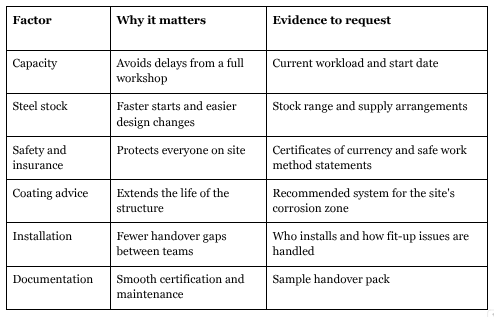
A fabricator that scores well across most rows is usually a safer pick than one with a slightly lower price and several blanks.
Common Questions About Hiring a Fabricator
Should the fabricator also handle installation?
It often helps. When one team fabricates and installs, any fit-up issue sits with a single business, which speeds up fixes and avoids disputes about who is responsible.
What insurance should a steel fabricator carry?
At a minimum, current public liability cover and workers' compensation insurance. Ask for certificates of currency rather than relying on a verbal confirmation.
Can a fabricator help if the engineering is still being finalised?
Many can provide early advice on section availability, connection types and buildability. Final fabrication should still wait until approved engineering drawings are issued.
Final Word
Hiring a fabricator well comes down to matching the workshop to the project at every stage: capacity and stock before signing, quality and coatings during production, careful delivery on site and complete records at handover. For builders and property owners planning steel work in South East Queensland, Metro Steel offers steel supply and fabrication from one Brisbane team, so a quick call with project plans is an easy way to check capacity, discuss finishes and lock in a realistic start date.


.svg)

.jpg)