Solar as an Investment: Payback, Tax Benefits, and Returns

.png)
Solar is not an expense. It is a 25-year income-producing asset. For business owners evaluating solar panels for sale, the real question is not whether solar pays off, but how fast and by how much.
Here is what the numbers actually look like, and what to watch out for.
The Core Financial Equation
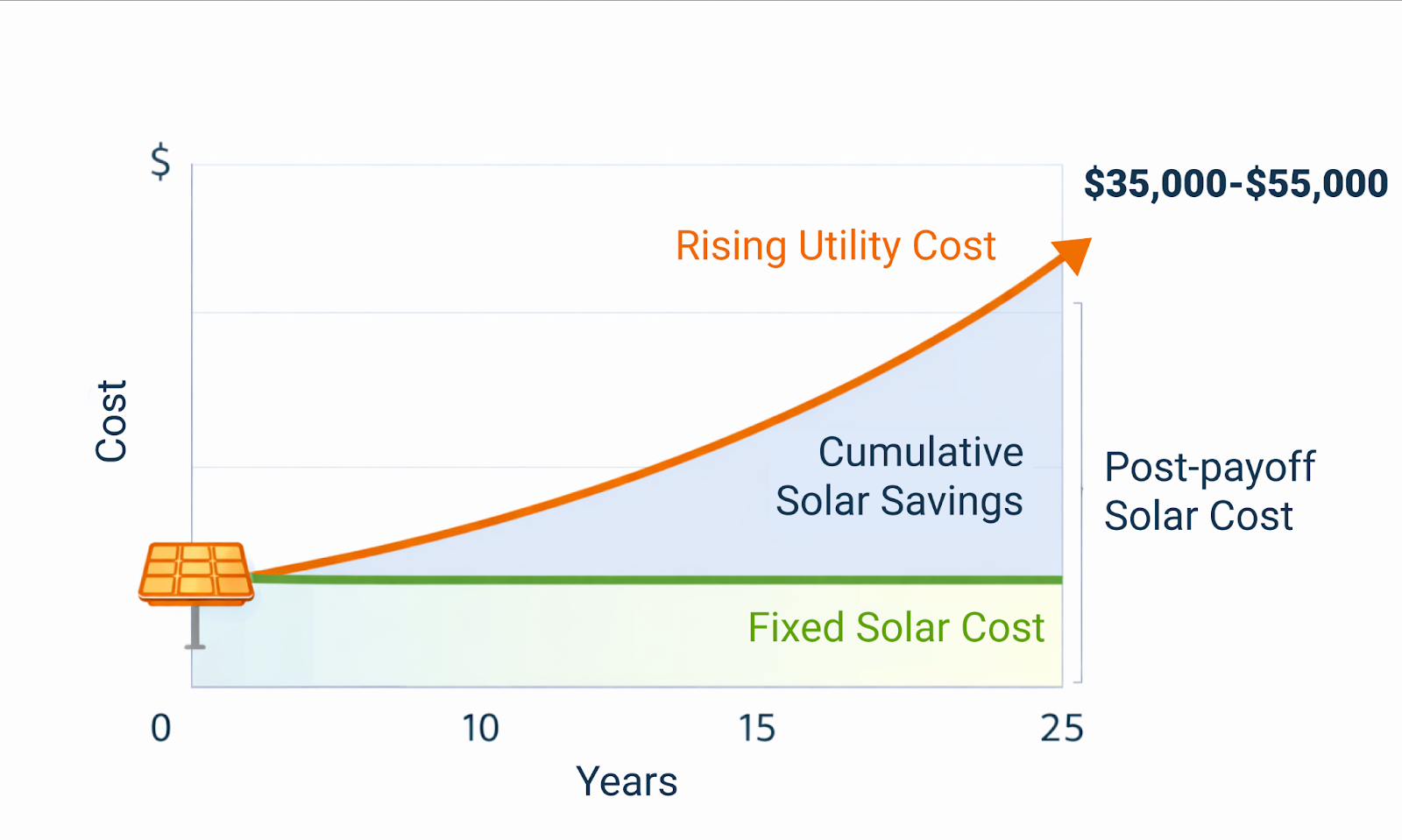
You pay for a system once. It displaces grid electricity for 25 to 30 years. Grid rates have risen 3 to 5 percent annually over the past decade, and that trend shows no sign of reversing. Your solar cost per kilowatt-hour is fixed the moment the system is paid off. Every year, the gap between what you would have paid the utility and what you actually pay grows wider. That compounding effect is the real investment case for solar, not just the first-year savings.
The U.S. Energy Information Administration reported average commercial electricity rates climbed roughly 24 percent between 2014 and 2024, while solar hardware costs dropped by more than 50 percent over the same period.
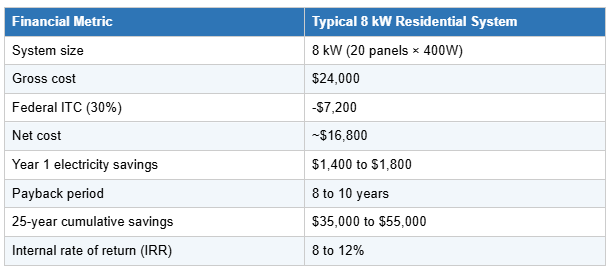
Figures are national averages. Results vary by location, utility rates, roof orientation, shading, and financing method.
Tax Incentives That Improve Returns
Federal Investment Tax Credit (ITC)
The ITC lets homeowners and business owners claim 30 percent of total system cost as a direct credit against federal tax liability. Dollar for dollar, not a deduction. On a $24,000 system, that is $7,200 off your tax bill.
One thing that catches people off guard: the ITC is non-refundable. It can reduce your liability to zero, but it will not generate a refund if the credit exceeds what you owe. The good news is that unused credit carries forward to future tax years, so most businesses with steady income will capture the full benefit within a year or two.
For commercial buyers, the ITC stacks with MACRS depreciation, and that combination is where the math gets genuinely compelling.
MACRS Depreciation (Commercial Only)
Businesses can depreciate solar assets over five years under the Modified Accelerated Cost Recovery System. The depreciable basis is calculated as the gross system cost minus 50 percent of the ITC amount. Depending on your effective tax rate, this can offset a substantial portion of system cost in years one through five, on top of the ITC.
Be cautious with "55 to 60 percent first-year recovery" figures that circulate in sales conversations. That range represents a best case for businesses with enough tax appetite to absorb the full benefit quickly. Run the numbers with your accountant against your actual liability before treating it as a guarantee.
State and Local Programs
Many states add rebates, net metering credits, performance incentives, or sales and property tax exemptions on top of the federal ITC. The DSIRE database at dsireusa.org is the most reliable public source for current programs by state. Availability and value vary significantly, so check your state before finalizing a project budget.
Next step for commercial buyers: Pull your last 12 months of utility bills and run a quick load analysis before talking to any installer. Knowing your actual consumption profile makes every subsequent conversation more productive and prevents oversizing.
Financing Options Compared
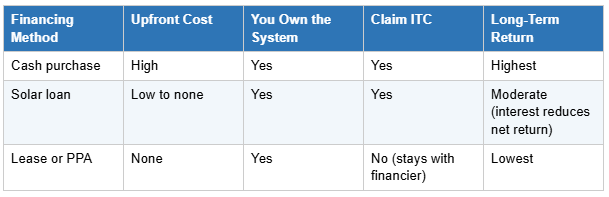
A cash purchase delivers the highest lifetime return because you capture all incentives and pay no interest. Solar loans, typically offered at 10 to 25 year terms, let you go solar with little or no money down while still claiming the ITC, though interest cost reduces your net return compared to cash.
Leases and PPAs require no upfront commitment but transfer system ownership to the financing provider. That means the tax credits go with them, not you. Total savings are lower, and the lease can complicate a property sale if a buyer does not want to assume it. For business owners especially, the loan or cash route almost always pencils out better than a lease.
Property Value Impact
A Lawrence Berkeley National Laboratory study found that homes with owned solar systems sold at a measurable premium over comparable non-solar properties. The average figure cited across multiple studies falls in the range of $3 to $4 per installed watt, which translates to roughly $24,000 to $32,000 on an 8 kW system. Other analyses place the premium at 3 to 4 percent of home value.
The consistent finding across the research: owned solar adds resale value in most U.S. markets. The premium is not guaranteed and varies by local buyer demand and system age, but ignoring it in your investment calculation understates the total return.
Risk Factors Worth Knowing
.png)
The main variables are utility rate trajectory, net metering policy, and incentive continuity. Historically, all three have moved in solar's favor. Rates have risen steadily, the ITC is locked in through 2032, and modern panels degrade slowly at roughly 0.4 to 0.5 percent per year.
The most active risk for new installations is net metering reform. Several states, including California with its NEM 3.0 transition, have cut the per-kilowatt-hour credit utilities pay for exported solar power. If your system is sized to export a significant share of production, reduced export credits shrink your returns.
The practical response is to design systems around self-consumption first, and to consider pairing solar with battery storage where export rates have dropped. A system that uses most of what it generates is far less exposed to net metering changes than one that relies on grid export for a significant share of its economics.
Maintenance Costs
Panels have no moving parts and require minimal upkeep. Periodic cleaning and an annual visual inspection cover most maintenance needs. The main planned replacement cost is the inverter, which typically lasts 10 to 15 years and runs $1,000 to $3,000 for a residential or small commercial string inverter.
Microinverter systems cost more upfront but allow individual unit replacement without taking the whole array offline, which matters for commercial installations where downtime has a real cost.
Budget for at least one inverter-related expense over a 25-year system life. Financial projections that ignore this tend to overstate net returns by a few thousand dollars.
Shop Solar Panels at A1 SolarStore
A1 SolarStore carries a wide selection of solar panels for sale from tier-one manufacturers at competitive prices. Whether you are a homeowner planning a first installation or a business owner managing a multi-site rollout, A1 SolarStore provides clear product specifications, real-time availability, and responsive customer support.


.svg)
.jpg)